
The Cunning Folk
Stories Worth Being Retold
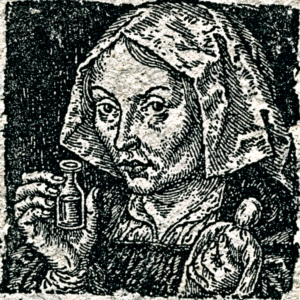
Margery Jourdemayne
Eye, near Westminster, burned 1441
♥ Queen of Hearts | Keyword: Hope
For decades, Margery Jourdemayne lived and worked from the manor of Eye, a stretch of marsh and meadow beside Westminster that her husband William administered for the Abbey for about twenty years. People who wanted a husband to love them, or a child they could not otherwise conceive, came to her there. She never advertised. She did not need to.
Her first brush with the law came in 1430, when she was arrested for sorcery and held at Windsor Castle for about a year and a half. She was let go in 1432 on her oath to stop. She did not stop. She went back to Eye and, more quietly than before, went back to work.
Among her clients, for at least ten years before anyone outside her circle knew it, was Eleanor Cobham. Before Eleanor married Humphrey, Duke of Gloucester, in 1428, it was said she had gone to Margery for medicines and drinks to make him love her and marry her. After the wedding, wanting the child that marriage never brought her, she went to Margery again. This was not treason. It was not even, under the law of the time, a crime at all. Wanting to be loved, and wanting a child, were not things a woman needed the church’s permission to want.
The trouble came from elsewhere. In 1441, two of Eleanor’s own household scholars were accused of casting a horoscope that predicted the young king’s death, a charge that reached toward treason because it reached toward the throne Humphrey stood to inherit. On 15 July that year, London was struck by a violent hailstorm, and its people blamed witches. It may have been in the chaos of that same week that the authorities came for Margery too.
Eleanor denied plotting the king’s death, but admitted, before a panel of bishops, what she had used Margery for. It was the safer thing to admit to. It also finished Margery. She was burned at Smithfield on 27 October 1441, the day after one of the accused scholars died in the Tower, and three weeks before the other was hanged, drawn, and quartered at Tyburn. A London chronicler writing at about the same time set her death down in a single line, and did not trouble to give her a name: on the eve of St Simon and St Jude, “the wycche be syde Westemyster” was burned in Smithfield. A third man, Eleanor’s chaplain, was pardoned outright and lived out his life undisturbed. Eleanor was sentenced by the church courts to public penance at three London churches on three days that November, at St Paul’s, at Christchurch, and at St Michael’s in Cornhill, and she kept her life, a castle, and a pension besides. Of everyone swept up in the affair, Margery was the only one of no rank at all, and she was the only one who burned.
The men who wrote about her afterward could not resist her. A verse written more than a century later called her Old Mother Madge, and swore she could command “feendes and fayries” and call the dead up out of their graves. Shakespeare put her on stage under her own name, conjuring spirits for Eleanor. None of it was true to what she actually did. What she actually did was smaller, and in its way harder to shake: for decades, she gave people what they came for. Hope, mostly. It was the one thing nobody ever proved was a crime, and the one thing they burned her for supplying anyway.
The image is a whimsical imagining based on the historical record, not an authentic portrait.
Sources:
G.L. Harriss, “Cobham, Eleanor,” Oxford Dictionary of National Biography (2004). Jessica Freeman, “Sorcery at Court and Manor: Margery Jourdemayne, the Witch of Eye Next Westminster,” Journal of Medieval History 30 (2004). Gemma Hollman, Royal Witches: Witchcraft and the Nobility in Fifteenth-Century England (2019). R.A. Griffiths, “The Trial of Eleanor Cobham: An Episode in the Fall of Duke Humphrey of Gloucester,” Bulletin of the John Rylands Library 51 (1969). Francis Young, Magic as a Political Crime in Medieval and Early Modern England(2018). Edward Hall, Chronicle (1548). Richard Grafton, Chronicle (1569), and Robert Fabyan, The New Chronicles of England and France (c.1516). William Gregory, Chronicle of London, in James Gairdner (ed.), The Historical Collections of a Citizen of London in the Fifteenth Century (Camden Society, 1876).
Foundational sources are available on The Sources page.