The Cunning Folk
Stories Worth Being Retold
Mary Bateman
Leeds, Yorkshire, 1768–1809
♠ Queen of Spades | Keyword: Guile
Mary Harker was baptised on 15 January 1768 at St Columba’s Church in Topcliffe, one of six children of a small Yorkshire farmer. She learned dressmaking in York, fled to Leeds after being caught stealing there, married a wheelwright named John Bateman, and raised at least five children with him. By 1799 she was practising as a cunning woman alongside her needle, and for the harder cases she claimed a distant wise-woman named Mrs Moore worked through her. Mrs Moore never existed. A second correspondent, Miss Blythe of Scarborough, took over later, writing letters that always had to be burned the moment they were read.
For a decade the deception cost her clients dearly. The Steads lost their savings to a rival Mary invented purely to work on a jealous wife. Judith Cryer, an old washerwoman, was shown a letter from the fictional Miss Blythe containing a drawn gallows, warning that her living grandson would hang before he turned fourteen unless she raised four guineas and had them sewn, unlooked at, into her bed. The Misses Kitchin, two Quaker sisters, died within ten days of each other in 1803 alongside their mother, all three under Mary’s nursing; a physician suspected poison and was refused the chance to look.
In 1806, while living at Black Dog Yard, one of her hens laid an egg inscribed “Christ is coming.” She arranged for two more to follow it from the same nest. Leeds was gripped that year by rumours that the world was ending, and crowds paid a penny each to see the eggs for themselves, some of them frightened into sudden, violent piety. It held only as long as no one caught her at it.
The case that hanged her began in 1806, when Rebecca Perigo came to her convinced an evil wish sat in her breast. For two years Miss Blythe’s letters set the price of the cure, money, linen, guineas sewn unopened into silk purses, and finally, in May 1808, six days of a doctored pudding, a powder added daily, with strict instructions never to call a doctor whatever happened. Both Rebecca and William ate it. William found it foul and stopped after a mouthful. Rebecca ate on, and died within the week. The powder was corrosive sublimate of mercury, a poison whose danger in quantity was well understood at the time. A decade of practice at keeping a fraud from close examination, set against a rising dose and a standing order to keep every doctor away, makes wilful poisoning the likelier reading of what happened in that kitchen, not a remedy that simply failed.
At her trial in March 1809 a surgeon identified the poison by taste, by the residue left on a blade, and by a dose fed to a dog that died as Rebecca had. She was sentenced to hang, claimed a pregnancy a jury of matrons found untrue, and spent her final days confessing to a prison chaplain fraud after fraud while refusing him a confession to murder, right to the gallows, with nothing left to gain either way by the lie. She wrote to her husband the day before, enclosing her wedding ring for their daughter: “I have made my peace with my God, and am easy in mind. To-morrow will end all here, and the Lord will care for me hereafter.” She was hanged at York on 20 March 1809 before a crowd of thousands.
What followed had more of the crowd in it than the court. Her body was sold for viewing at Leeds General Infirmary, threepence a head. Her skin was tanned and sold on as protective charms, the very object her own trade had dealt in for years, now made from her. Two books were bound in it. Her skeleton stood in a museum case into the twenty-first century. History has settled on calling her a witch and a poisoner. She was certainly the second. The first was never a charge the law could bring by 1809.
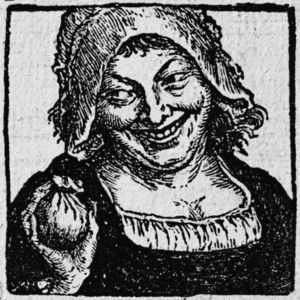
The image is a whimsical imagining based on the historical record, not an authentic portrait.