The Cunning Folk
Stories Worth Being Retold
Ursula Kemp
St Osyth, Essex, executed 1582
♦ Jack of Diamonds | Keyword: Undoing
Ursula Kemp was a cunning woman of St Osyth in Essex, a poor parish on the flat coastal edge of the county where the sea fret rolls in off the Blackwater and people’s lives were lived close to the bone. Ten years before anyone accused her of anything, she was already curing it. Crippled herself with a lameness in her bones, she learned a real charm from a woman in the next parish, hog’s dung and chervil held in the left hand, a knife pricked through it and cast into the fire, sage and herb of grace steeped in ale night and morning, and got well. She used the same charm on her neighbours for a decade after, at their own asking, and made her living by unwitching, finding the source of harm and taking it off again. She insisted, more than once, that though she could unwitch she could not witch. That distinction would not save her.
The trouble properly began with Grace Thurlowe. Grace had once let Ursula nurse her sick son back to health, then refused to let her nurse her newborn daughter, Joan, and the two fell out over it. When Joan later fell from her cradle and died three days after, of a broken neck, Ursula’s reported answer was that it served Grace right, she might have let her keep and nurse the child. The women fell out again not long after, this time over money: Ursula cured Grace’s own lameness for a promised twelve pence, Grace refused to pay, and Ursula told her she’d be even with her. Grace was struck lame again that same day. A neighbour’s infant, carried past Ursula’s house soon after, was heard crying “wo, wo” and pointing at her window, until its mother’s own conscience gave out and she went to complain.
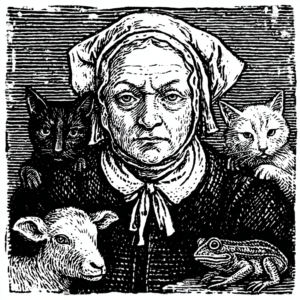
It was Ursula’s own eight-year-old son, Thomas Rabbet, who first said aloud what she’d kept quiet: four spirits, fed on beer, cake, and her blood, Tittey a grey cat, Jack a black cat, Pigin a black toad, Tiffin a white lamb. Promised mercy by the magistrate Brian Darcy if she confessed plainly, Ursula broke down and gave him everything, then added something nobody had asked: she’d sent Jack to kill her own sister-in-law, for calling her whore and witch. Nobody had to take her word alone for that. Her brother-in-law swore independently, at the same trial, that as his wife lay dying, cold and barely breathing, Ursula arrived at the house uninvited, lifted the sheets, and took her by the arm, and she drew no further breath after. When another suspect was searched for the marks a spirit’s feeding was said to leave, the searchers held her body up against Ursula’s own, so well known by then were the marks on her skin. She was formally charged with three deaths, not one dispute over an unpaid fee. Darcy’s promised favour never came. She and one other woman, Elizabeth Bennett, were hanged in 1582.
Fourteen women stood accused in the St Osyth panic that year. Only Ursula and Elizabeth were hanged. Alice Newman, the neighbour Ursula’s own confession named alongside her, wasn’t executed at all. She sat in gaol for six years and was released under a general pardon in 1588.
That wasn’t quite the end of her story. In 1921, a skeleton was dug up in a St Osyth garden, its joints pierced with iron, in the old belief that this would stop a witch from walking after death, and it was taken to be hers. It was sold, displayed, and passed between a Cornish museum and an eccentric painter’s private collection, before finally being reburied in the village in 2011, still believed to be Ursula. The best modern scholarship on the case says otherwise: a man’s skeleton, misidentified from the very first dig. Ursula, apparently, is still out there somewhere.
The image is a whimsical imagining based on the historical record, not an authentic portrait.