The Cunning Folk
Stories Worth Being Retold
James Murrell
Hadleigh, Essex, c.1785–1860
♠ King of Spades | Keyword: Command
James Murrell was born in Rochford, Essex, in 1780, the seventh son of a seventh son, which in the folk reckoning of the day meant his gifts were settled before he had done anything to earn them. He was apprenticed young to a surveyor in Burnham, worked for a time as a chemist’s stillman in London, and by about 1810 had set up as a shoemaker in Hadleigh, on the northern shore of the Thames Estuary. There he stayed for the rest of his life, mending shoes with one hand and, by common local agreement, ruling as the most formidable cunning man in Essex with the other. He married Elizabeth Button in London in 1812 and fathered as many as twenty children.
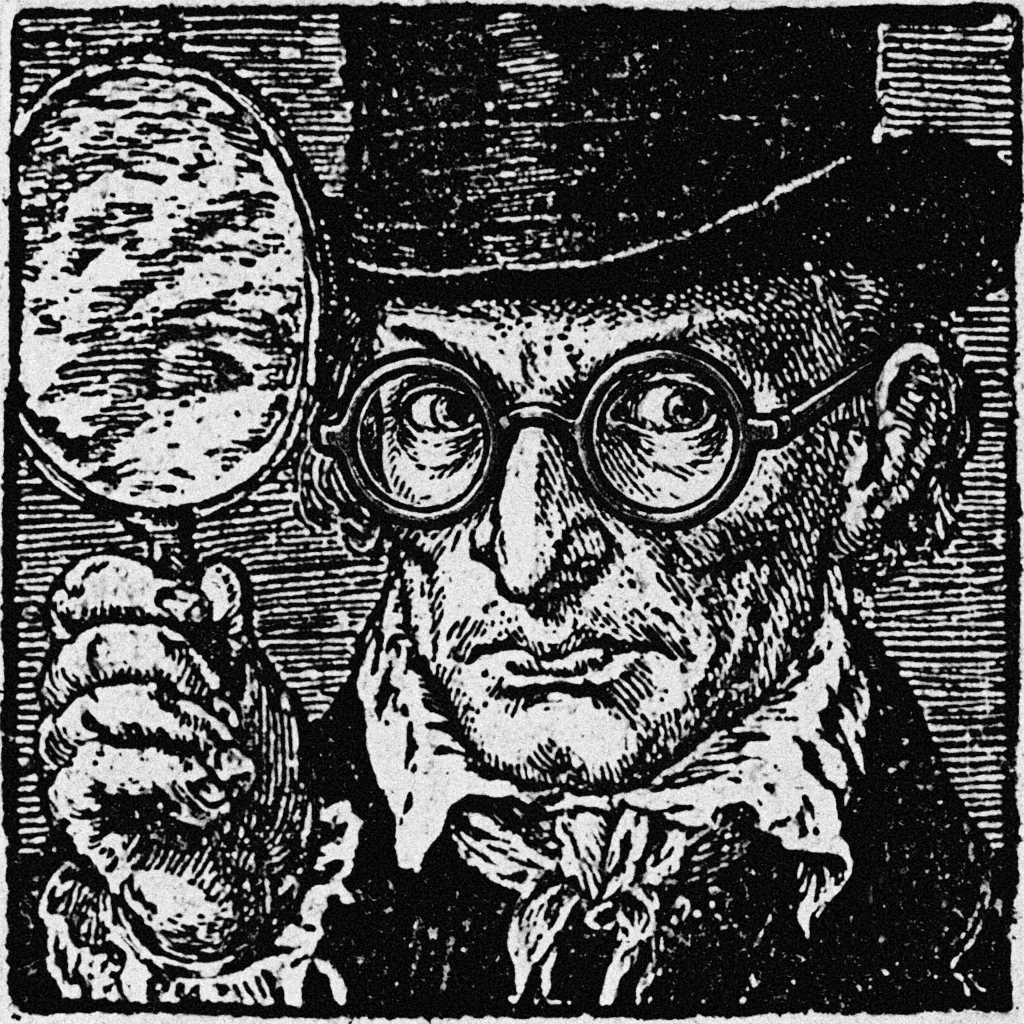
He called himself the Devil’s Master, and by every account meant it as his daily boast, not a modest claim. He argued theology with the clergy who called on him and generally won: one parish rector, pressed to say which he thought Murrell was, a very good man or a very bad one, admitted he could not make up his mind, since the wizard knew his own Bible better than the rector did. Murrell was, by every surviving account, a very small man: hard hat, bobbed tail coat, hands clasped behind him, walking the lanes humming loudly and lost in thought, a basket and a whalebone umbrella never far from his hand. He wore iron goggles that gave him a frightening appearance and scared off children, of whom he was actually very fond. Among his effects after death was found a trick telescope, once boasted to let a man see clean through a brick wall.
He preferred to travel by night, and was said to cover impossible distances doing it. One story has him crossing the River Crouch on a broomstick. Another has him vanish from a crowd of old men on Canvey Island and reappear, at almost the same moment, in his own village, miles off.
He told many witch-bottle stories in his time; this is one of them, told in full here rather than blended with the others. A young woman found an old gypsy hiding in a barn and turned her off the property. The gypsy, a witch, cursed her for it, and the girl began to scream like a cat and bark like a dog. Murrell was sent for. He set a bottle holding the girl’s hair and nail clippings on the fire and told the room to stay silent while they waited the witch out. A hammering started on the door, and a woman’s voice begged him to stop, the test was causing her agony. The bottle burst. The next morning an old woman was found burned to death outside the Woodcutters’ Arms, three miles away. It was the gypsy. The girl recovered.
His reputation reached both banks of the Thames Estuary. He told the people of Leigh, Hadleigh and Canewdon what the future held for witchcraft in each of their parishes, and they were still repeating it generations later. The gentry despised him as a dangerous quack in public and consulted him in secret; the poor never bothered with the pretence. When he died, the registrar recorded his occupation with the same disdain: “Profession Quack Doctor: Natural Causes.”
He predicted his own death to the minute, and died on 16 December 1860 precisely when he had said he would. His trunk of magical books and papers was buried by his landlord and dug up again by his son. Arthur Morrison examined the contents before they were dispersed: astrology and astronomy books, old medical texts, home-made manuscripts on conjuration and geomancy, an annotated Culpeper in Murrell’s own crabbed hand. His correspondence was burned in 1956 by people who did not know what they were destroying, but the trunk survived, and so did one notebook of astrological records, later examined by a folklorist and found to carry nativities cast for Queen Victoria, Melbourne, and Wellington among its pages.
He is buried in Hadleigh churchyard in an unmarked grave, beside most of his own children. Years afterwards his son led Arthur Morrison to the spot, by then no more than a faint discolouration in the turf. Murrell would probably have thought an unmarked grave beneath his dignity.
The image is a whimsical imagining based on the historical record, not an authentic portrait.
Sources:
Arthur Morrison, “A Wizard of Yesterday,” The Strand Magazine (1900). Eric Maple, “Cunning Murrell: A Study of a Nineteenth-Century Cunning Man in Hadleigh, Essex,” Folklore 71 (1960). Eric Maple, The Dark World of Witches (New York: A.S. Barnes & Co., 1962), cited via Rosemary Ellen Guiley, The Encyclopedia of Witches, Witchcraft and Wicca(1999/2008), p. 239. Owen Davies, Popular Magic: Cunning-folk in English History (2003). Ronald Hutton, The Triumph of the Moon (2019 rev. edn.), ch. 6.
Foundational sources are available on The Sources page.