The Cunning Folk
Stories Worth Being Retold
John Wrightson
Stokesley, Yorkshire, d. uncertain, sometime after 1815
♦ King of Diamonds | Keyword: Extravagance
On Trinity Fair day in 1808 a man walked into Stokesley market place with his face coloured vermilion and his long brown hair loose across it. Red coat, white waistcoat, black small clothes, white stockings, a drab hat. One who saw him thought he looked more like a maniac than a wise man. Nobody forgot it, and that was the point.
He had come from Sedgefield the year before, about forty-five, selling gingerbread from a thatched cottage at the west end of town. He was the seventh son of a seventh daughter, which settled the question of his abilities before he had done anything at all. He said himself he had no power beyond any other man, except when fasting.
His trade card gave nothing away. J. Wrightson, cow doctor, a seventh son, Stokesley, offering to relieve any inward disorder by the sending of water. It said nothing about witchcraft, the one part of the trade no cunning man put his name to in print. They came anyway, and not only the poor: to have a thief named, a beast cured, a fortune told, or to be kept out of the militia ballot. Whatever the complaint, he laid it at the door of witchcraft.
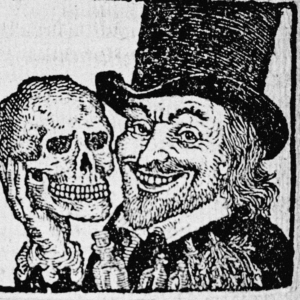
He kept a dark room and read aloud there from an ancient folio in black letter, and people came out of it saying he had told them what marks were on their own bodies, having never set eyes on them before. In his consulting room he wore a long robe and a strange head-covering, a skull and a globe and dried herbs about him. On Sundays he put on a scarlet coat and crimson knee-breeches and went to church to stand godfather to the children of Stokesley, which he was asked to do constantly, despite a private character those who knew him called very bad. They asked him anyway.
He knew before you spoke.
Two cattle buyers lost two cows on the road from Northallerton fair and came to test him, agreeing to say it was a horse. They were barely through the door when he shouted from the scullery that if they could turn two cows into a horse it was no use coming to him, for he could not turn a horse back into two cows. Then, after a long silence: they are both in the beck, and have been since last night. Both were found a mile below the bridge, drowned in the swollen Leven.
John Unthank rode eleven miles over the moor about his uncle’s sick beast and got no chance to speak. Thou’s come to ask me about Tommy Frank’s black beast. Then Wrightson gave him his uncle’s parting words before he could recall them himself: mind and see t’ galloway gets her whoats afore you leaves t’ stable. He described the animal better than Unthank could, said it was past saving, and said they would find the growth that killed it when they opened it. They did.
A lady in South Durham lay dying of a lump in her throat and her son rode for Stokesley. Before he reached the door Wrightson called out to him. Bait your horse, get something to eat, and go home. The lump has burst. She is all right now.
Old Nathan Agar hid five golden guineas in a stocking foot under his thatch, went to add a sixth, and found the lot gone. He told nobody and went straight to Wrightson, who reminded him first that he had been warned, at sixty, against marrying a girl not quite nineteen. Then: lift the flag at your doorstep when the house is empty, lay a certain leaf of the Bible beneath it, and watch who stumbles coming in. The lodger stumbled. Then the wife. Agar was told where his guineas lay in the pig-sty, along with a watch he had not missed, and other and more serious things besides, which ended his marriage that week.
Two men coming down the moor road above West House turned aside for a bit of sport with Auld Wrightson. He welcomed them warmly, sat them at the fire, gave them pipes and tobacco, and heaped on the fuel. When the heat grew past bearing they went to edge their chairs back and found the chairs would not move and they could not rise from them. He let them roast, then remarked that Auld Wrightson reckoned it a sport differing somewhat from the one they had settled on coming down West House bank, and another time they might think twice. And now, good do to you. As he spoke they came loose.
A young bull went down too weak to stand, slung in ropes to keep it off the ground. Wrightson came, refused to look at it, lit his pipe and strolled out alone to the byre. When the men followed, the bull was standing without the slings and eating with a hearty appetite. How it was done, he never said.
A quarryman came about stolen tools and was told at once that nothing could be done, they had been carried across water. But he could be shown. Put before a looking glass in a darkened room and warned not to look away, he saw his tools lying in bracken in a wood he knew at once. He was told not to touch them, and to bring back a live magpie. He could not catch one, and no boy would give up his. Without it, Wrightson said, he could work the thief no harm.
His household worked for him as hard as he did. An elderly housekeeper, an odd-job man, an ally among the ostlers at a Stokesley inn, and a code of signals between them, so that everything worth knowing about a visitor reached the master before the visitor did. A stranger who stabled his horse before walking round had already told more than he knew. Whether that accounted for all of it, nobody who knew him could agree. Some came away certain he had real and marvellous power, others that he was a swindler and nothing more, and one who could not settle it wondered whether men of his trade practised something like electro-biology, knowingly or not. Seventy years after his death they were still arguing.
He could not pass it on. He said plainly he could not give his powers to his own son. The books went to a nephew, remembered in Stokesley as Jacky Dawson, who took up the trade and was never thought worthy of it.
The end came in custody. He had been committed to the House of Correction at Northallerton for an assault, and the officer taking him there found him dead in the post chaise. Nobody recorded the year, or the cause, or where they buried him.
He was, said one who tracked down everyone still living who had known him, undoubtedly a man endowed with marvellous psychic power, and with the smallest amount of charlatanry possible. Another, who thought a great deal less of him, called him little better than a huge swindler.
The image is a whimsical imagining based on the historical record, not an authentic portrait.