The Gifts
The Aces — The Four Gifts
The fifty-two other cards in this deck are built from the objects, practices and people of the English cunning folk tradition. But the four Aces are different. An Ace is not an object, and it is not a practitioner. It is the question every practitioner’s story eventually answers: where did the power come from in the first place?
The domains each Gift serves are as follows: Hearts are Love & Home, Diamonds are Health & Healing, Clubs are Knowledge & Fortune, and Spades are Soul & Shadow.
The historical record describes four distinct ways cunning folk were believed to come into their power: born with it, given it by something not of this world, earned through years of study, or passed to them at another’s death. Each Ace names one of these. Not a person, and not a single incident, but the shape of an origin that repeats across many names and many centuries.
Turn the Ace and you are at the root of everything that follows.
Ace of Hearts
Innate Power
The Gift received by Blood.
Some children arrive already marked.
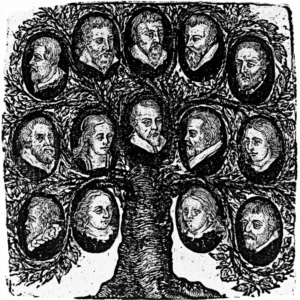
The seventh son, the seventh daughter: across England this was no idle superstition but a working credential. Mary Cox, a nineteenth-century wise-woman of Plymouth, defended her trade to the local Board of Guardians on exactly this ground, she was the seventh daughter of a seventh daughter of a seventh daughter, and the healing was hers by right of birth alone. John Wrightson, the cunning man of Stokesley, made the same claim. No apprenticeship explained it. No encounter granted it. It was simply there, counted into the family line before the child had done a single thing to deserve it.
Its name in this deck is Innate Power. Not luck, and not inheritance in the ordinary sense, the specific, documented belief that some are born already carrying what others spend a lifetime trying to earn.
That is what Hearts is. The household is owed nothing. It simply has, already, what it needs.
Ace of Diamonds
Otherworldly Gift
The Gift received by Contact.
Some are taken, briefly, by something that does not belong to this world, and return changed.
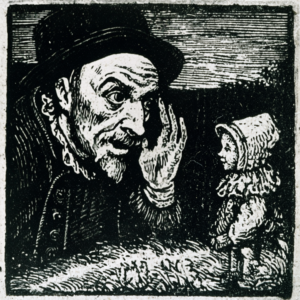
A cunning man from the North of England, at whose trial the Yorkshire schoolmaster John Webster was present, said it happened on the road home. He was walking back from his labour one night, “being very sad and full of heavy thoughts, not knowing how to get meat and drink for his Wife and Children,” when a “fair Woman in fine cloaths” stopped him and asked why he was so sad. He told her it was his poverty, and she said that if he would follow her counsel she would help him. Webster thought him “a very simple and illiterate person to any mans judgement,” and recorded what her counsel came to: a man “formerly very poor,” afterwards keeping “himself, his Wife and diverse small children, by his cures.” He confessed the whole of it in open court and was acquitted anyway.
Its name in this deck is Otherworldly Gift. It cannot be studied for, and it cannot be inherited. It simply arrives, once, from outside, and does not leave again.
That is what Diamonds is. The body wants to heal. Sometimes it is only by what visits it.
Ace of Clubs
Earned Mastery
The Gift received by Graft.
Some gifts are given to ourselves. They are built, alone, over years no one was watching.
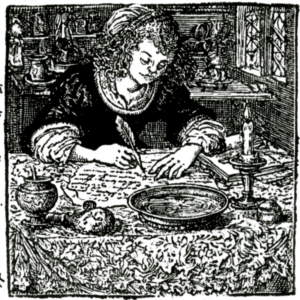
George Clegg, a cunning man, had studied astrology since he was fifteen, forty years of calculating nativities and locating lost goods before a stranger ever saw him do it easily. Anne Bodenham, questioned by an eyewitness near the end of her life, put the whole method plainly: “she could raise Spirits by reading in her Books.” The libraries of cunning-folk like “Owd Rollison” of Worsley held worn, heavily used copies of Agrippa, evidence not of sudden insight but of decades spent with the books open.
Its name in this deck is Earned Mastery. The only one of the four that asks something of the person who receives it, before it will answer.
That is what Clubs is. The thing you are looking for was never going to be found by chance.
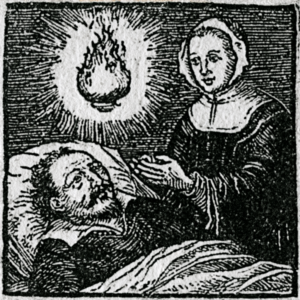
Ace of Spades
Inherited Craft
The Gift received by Choice.
Some gifts exist only because someone has died and passed it on to a chosen one.
This was one of the most common ways cunning folk were believed to come into their power. Margaret Ley, a Liverpool witch tried in 1667, testified that when her mother died she had nothing else to leave her two daughters but her two familiar spirits, one named to Margaret, the other to her sister. Cunning practice passed the same way more than once. Richard Morris was trained in his youth by his aunt Deborah Heathcote, and took up her practice after her death. Hannah Spence succeeded her own mother, the celebrated Yorkshire wise-woman Hannah Green, when Green died in 1810. One of Timothy Crowther’s sons took over his father’s trade.
Among charmers, a closely related tradition, the belief ran further still: a charm could be withheld entirely until the charmer’s final hour, and was thought to fail completely unless it passed to someone of the opposite sex. Not automatic. Not given to whoever happened to be standing nearest. Chosen, and only at the very end.
Its name in this deck is Inherited Craft. It is not loss. It is the one moment a gift can change hands complete, entire, with nothing of it left behind.
That is what Spades is. Something ends, so that something else can finally begin.
Sources:
Ace of Hearts
Owen Davies, Popular Magic (2003), p.70. Owen Davies, “Cunning-Folk in England and Wales during the Eighteenth and Nineteenth Centuries,” Rural History 8:1 (1997), p.98. Keith Thomas, Religion and the Decline of Magic (Weidenfeld and Nicolson, 1971), pp.200-202. Simon Young, “What’s Up Doc? Seventh Sons in Victorian and Edwardian Lancashire,” Folklore 130:4 (2019), pp.395-412.
Ace of Diamonds
Owen Davies, Popular Magic (2003), pp.70-71. Emma Wilby, Cunning Folk and Familiar Spirits (2005), pp.60, 66-67, 68, 82, citing John Webster, The Displaying of Supposed Witchcraft (1677), pp.301-302.
Ace of Clubs
Edmond Bower, Doctor Lamb Revived (London, 1653), p.25. Owen Davies, Popular Magic (2003), pp.43-45, 136-137, 145. Emma Wilby, Cunning Folk and Familiar Spirits (Sussex Academic Press, 2005), p.78.
Ace of Spades
Emma Wilby, Cunning Folk and Familiar Spirits (Sussex Academic Press, 2005), pp.60-61. Owen Davies, Popular Magic (2003), pp.72-73, 82-83. Owen Davies, “Cunning-Folk in England and Wales during the Eighteenth and Nineteenth Centuries,” Rural History 8:1 (1997), p.97. Ronald Hutton, The Triumph of the Moon (Oxford University Press, 1999), ch.6.
Foundational sources are available on The Sources page.