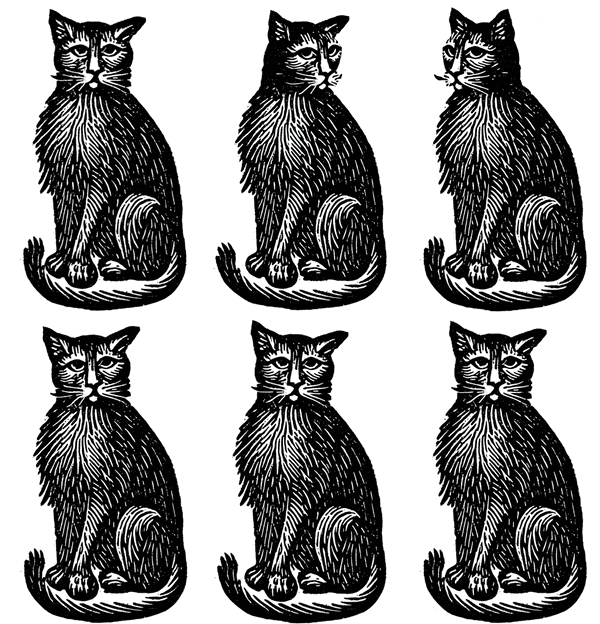
The Powers
The Jokers – The Two Powers
The fifty-two cards of this deck describe the objects, practices and people of the English cunning folk tradition. The two Jokers describe something different: the world those people inhabited, and the two powers between which every one of them operated.
These were not obscure forces known only to practitioners. Every man and woman in sixteenth- to nineteenth-century England knew them. Providence: divine will moving through events, ordained and unstoppable, forever restoring the world to what was meant to be. And Opposition: the power that ran counter to it, met in bargains struck out of desperation, that would bend what was meant to be, for a price. Church and chapel named them from the pulpit. The cunning folk met them in their work.
The cunning folk identified with Providence. They healed in God’s name, worked their charms in Christ’s authority, and presented themselves, honestly for the most part, as people who worked with the divine, not against it. But they stood closer to the boundary than anyone else in their communities. Some moved toward Opposition, consciously or not. Some were accused of it regardless. The two cards that follow give these powers their most historically documented faces: the forms they took when they became visible enough to be recorded.
The Man in Black
Opposition
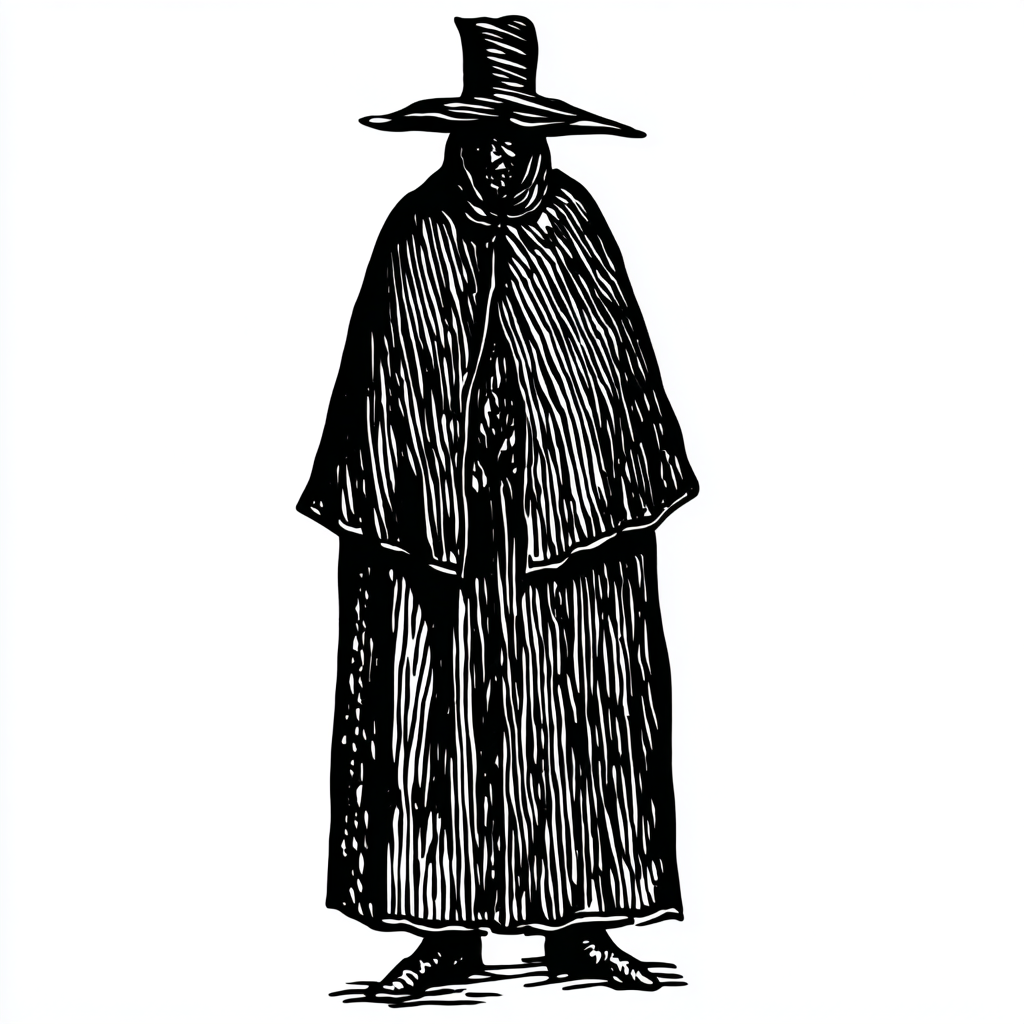
He is the face Opposition wore when it became visible enough to write down.
In Huntingdonshire in 1646, a spirit appeared to Jane Wallis as she made her bed and gave his own name as Blackman, standing before her “in the shape of a man in blacke cloaths.” In Somerset in 1665, Elizabeth Style and Alice Duke called him only the man in black, the same phrase the record repeats every time he appears. He brought the wax image to be baptised in a child’s name, stood godfather to it, and supplied the wine, the cakes and the roast meat while the company danced. A year before that, in the same county, a different group met a lighter version of him: “a little Man in black Clothes” who tipped his hat and asked, low voiced, “How do ye?” before he asked for anything at all. In Lancashire in 1634, Margaret Johnson’s own demon came to her better dressed than most men she knew, “apparelled in a suit of black tied with silk points.”
These are witch trial records, not the records of cunning folk practice, and that distinction should not be blurred. But the world was small, and cunning folk and their clients moved through the same landscape these trials describe. Very few cunning folk were ever prosecuted under the Witchcraft Acts; ordinary people drew a clear line between a witch’s familiar and a cunning person’s craft. The Man in Black stood on the far side of that line, the adversary the whole trade existed to counter, not a figure any of them would have claimed as their own.
He comes closest to their actual practice in the case against Anne Bodenham, a Salisbury woman who found stolen goods in a green glass and charged twelve pence for it, and who is named in the record itself as “the cunning woman.” When her accuser Anne Styles fell into her fits, a boy in the room, too frightened to leave, saw “a spirit in the likeness of a great black man, with no head,” come to claim her soul. Awaiting her own trial, Bodenham gave her account of such spirits to a friend who visited her, in her own words: there was no hurt in them, she said, only that “they would doe a man all good offices, attending upon him and guarding him from evil all his life long.” Two witnesses, describing the same kind of figure from opposite ends of the same case, and neither one uncertain about what they had seen.

The Angel
Providence
She is the face Providence wore when it arrived in person: vivid enough, documented enough, that she stands here as the embodiment of the divine power the cunning folk claimed. Not the only form that power took. But the one that gave it a presence, a figure, a face.
Joan Willimot, a Leicestershire cunning woman examined in 1618, described a spirit that stood upon the ground in the shape of a woman, sent by a mysterious master to do her good. James Murrell, the last great cunning man of Essex, summoned good spirits and angels to fight the bad ones. These were not theological abstractions. They were presences: encountered, described, worked with.
But the Angel was the visible face of something much larger. Providence expressed itself in ways that had nothing to do with angelic visitation: in the words Christ, Trinity, Holy Ghost spoken over the sick. Bridget Bostock healed six hundred people a day with fasting spittle and prayer. She never mentioned an angel. She did not need to. Providence was already moving.
This was the register the cunning folk’s communities recognised, the framework that kept most of them from the gallows. Not because it was a performance, but because it was real. Providence was genuinely what most of them believed they were working with, most of the time.
There are powers at work beyond your control. Trust them. Allow Providence to guide what comes.
Sources:
The Man in Black:
John Davenport, The Witches of Huntingdon, Their Examinations and Confessions (London: W. Wilson for Richard Clutterbuck, 1646); Joseph Glanvill, Saducismus Triumphatus: or, Full and Plain Evidence Concerning Witches and Apparitions (London, 1681); Edmond Bower, Doctor Lamb Revived, or, Witchcraft Condemn’d in Anne Bodenham(London: T. W. for Richard Best and John Place, 1653); Doctor Lambs Darling: or, Strange and Terrible News from Salisbury (London, 1653); Henry More, An Antidote Against Atheism, 2nd edn (London, 1655); Emma Wilby, Cunning Folk and Familiar Spirits: Shamanistic Visionary Traditions in Early Modern British Witchcraft and Magic (Brighton: Sussex Academic Press, 2005); James Sharpe, “In Search of the English Sabbat: Popular Conceptions of Witches’ Meetings in Early Modern England,” Journal of Early Modern Studies 2 (2013): 161–183; and Deborah Lea, “Witchcraft, Possession and Confessional Tension in Early Modern Lancashire” (PhD thesis, University of Liverpool, 2011).
The Angel:
Joan Willimot’s examination, in The Wonderful Discoverie of the Witchcrafts of Margaret and Phillip Flower (1619), full text at quod.lib.umich.edu. Arthur Morrison, “A Wizard of Yesterday,” The Strand Magazine, vol. 20, no. 118 (October 1900), pp.433-442. Jane Shaw, “Bostock, Bridget,” Oxford Dictionary of National Biography (2004). Owen Davies, Popular Magic: Cunning-Folk in English History (Hambledon Continuum, 2003). Emma Wilby, Cunning Folk and Familiar Spirits (Sussex Academic Press, 2005). Keith Thomas, Religion and the Decline of Magic (1971).
Foundational sources are available on The Sources page.