The Cunning Folk
Stories Worth Being Retold
Bridget Bostock
Coppenhall, Cheshire, c.1678–after 1749
♦ Queen of Diamonds | Keyword: Vocation
Bridget Bostock healed her neighbours for years before anyone outside the parish noticed, sore legs, aches, the ordinary complaints of a working village. Her method never changed: spittle taken before she’d eaten anything that morning, believed to carry a particular virtue, worked into the sufferer along with touch and prayer, and a little liquor of a red colour she never once explained to anyone who asked. Her own minister, William Harding of Coppenhall, said his son’s lameness was cured the moment he’d been in her company, “when all other doctors could do him no service.”
Then, in August 1748, a local newspaper printed a piece about her, and Coppenhall stopped being a place nobody had heard of. A year earlier she’d had perhaps forty visitors in twelve months. By spring it was a hundred a week. By late summer, a hundred and sixty. Then, within days of each other, six hundred in a single day, then seven hundred. A letter to the Whitehall Evening Post listed what she’d cured: the blind, the deaf, the lame of every kind, King’s Evil, fits, dropsy, palsy, leprosy, cancers, “and in short almost every thing,” by nothing more than stroking with her spittle and praying over the sufferer. She turned away only one complaint, syphilis, what the period called “the French disease.” The letter went further still: of everyone who came to her, it claimed, not one went home uncured.
That claim didn’t survive the year after. A gardener from Thame, Christopher Lucas, brought three people to the great hall house she’d lately taken: his own wife, palsied; a woman blind five years; the wife of a London grocer, given up by the city’s hospitals as incurable. Only the grocer’s wife walked away well. The other two, the record says flatly, remained exactly as they’d arrived. Not every story about her ends in wonder. This one is told anyway, because it happened.
The walls of her house were papered floor to ceiling with the names of everyone she’d treated, near a bushel more stored above stairs. Not proof of any cure, she said. Only reminders to pray for them.
A grieving widower wrote to her that December with the boldest request anyone ever put to her: come to Wales and raise his wife from the dead, or, if the journey was too much to ask, simply pray her back to life from home. Sir John Price of Buckland had lost his wife Eleanor, and for a full year he pressed his case letter after letter, building an argument from scripture, Moses returned at the Transfiguration, Ezekiel’s dry bones, the graves that split open at the Crucifixion, proof, he argued, that no length of time was too long for God to undo. She never made the journey. Price came to believe it was the travel itself she balked at, not any doubt in her own power, and offered that her prayers alone, worked at whatever distance she liked, would do just as well. She refused him every time, never once suggesting the power wasn’t hers, only that it wasn’t hers to use that way.
A Methodist minister, John Bennet, watched her work twice and wrote up both visits, unable either time to explain what he’d seen. John Wesley heard it from him directly and didn’t doubt a word.
After 1749 she vanishes completely: no death date, no burial, not another line. She’d spent barely a year as one of the most talked-about women in England, healed what she could, admitted plainly what she couldn’t, and asked nothing back for any of it. Then, as suddenly as she’d arrived, she was gone from the page.
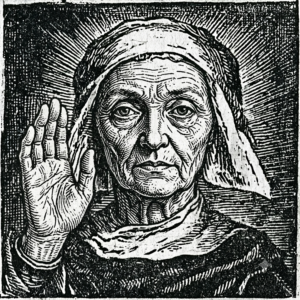
The image is a whimsical imagining based on the historical record, not an authentic portrait.