
The Cunning Folk
Stories Worth Being Retold
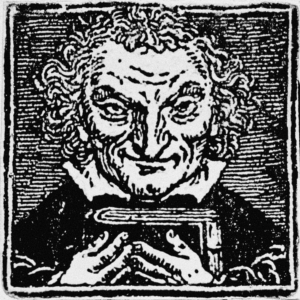
Timothy Crowther
Skipton, Yorkshire, 1694–1761
♠ Jack of Spades | Keyword: Assurance
Timothy Crowther was Skipton’s parish clerk for most of his adult life, and its most celebrated conjuror besides. A century after he died, people in the town were still saying “as cunning as Crowther” when they meant the highest compliment they had. He earned it.
In the summer of 1760, two neighbours from Bradford came to his door about a man missing twenty days. Crowther would not discuss it until they brought him a boy, twelve or thirteen years old. They returned with Jonas Rushford, fourteen. Crowther had him lie down and covered him over completely, a looking-glass placed in his hand, then asked what he wanted to see. Rushford asked for his mother, and saw her at once: a lock of wool in her hand, standing exactly where she was standing, dressed exactly as she was dressed. Only then did Crowther ask him to look again, for the missing man.
Rushford saw him riding drunk towards Idle, stopping at an alehouse for two more pints, a guinea out to pay for them. He saw two men, one big, one small, fall in behind him on the road, arm themselves with hedge-stakes, and pull him from his horse at the top of Windle Common. He watched them kill him and put him in a coal pit. The next day he led the search party to that exact spot. The body was there, the handkerchief tied about the mouth and fastened behind the neck, precisely as he had said. This is not a traveller’s tale, smoothed by a century of retelling. It is John Wesley’s own journal, in his own hand, dated the twenty-fourth of July, 1761. Wesley wrote the whole account down and closed it with a line that still splits opinion two and a half centuries on: “They that can believe this may believe a man’s getting into a bottle.”
Crowther kept a notebook, found on a Skipton bookstall a hundred years after he died, full of the working parts of his trade: astrological tables, weather signs, aphorisms on sickness and the revolutions of the stars, and his charms in his own hand. One, for stolen goods, calls on Sathan and four other named spirits, by the power of Heaven, to bring the thief before a wax plate marked with the planets and buried in the ground, repeated day after day until the thief or the goods appear. Another, for cattle harmed by a witch, takes hair from each of the beast’s four quarters and each hoof, sews it into a pin-stuck cloth ball, and boils it until the pan is fit to crack, while the charmer says three times over: “Witch, witch, witch, thus shalt thou burn in hell.” A man does not write his own incantations, in his own hand, in a book meant for no eyes but his, unless he believes in what he is writing.
He could also just be a nuisance, when it suited him. As parish clerk, he decided Skipton’s church bells were cracked and beneath the town’s dignity, and asked the churchwardens for a whole new peal. They refused outright. So he asked, more modestly, whether new clappers might at least be allowed. That seemed reasonable enough, and they agreed. The clappers he ordered were enormous. The first time the bells were rung with them, every one of them cracked. The peal the wardens had just refused him was now, suddenly, unavoidable.
He died in February 1761, five months before Wesley ever wrote down Rushford’s account of him. It made no difference to the proverb. A hundred years on, Skipton was still saying it.
The image is a whimsical imagining based on the historical record, not an authentic portrait.