The Twos — The Mixing
The space where things meet.
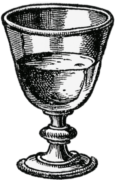
2♥ The Love Potion · Attraction
A love potion was exactly what it sounds like: a drink, given to someone, meant to make them fall in love with whoever gave it. Cunning folk made them to order. A client’s wanting went into the cup, the other person drank it and without knowing why felt an attraction that had not been there a moment before.
Margery Jourdemayne, this deck’s own Queen of Hearts, sold drinks like this to courtiers for years, long before the wax figures and the plot against a king that would later cost her life. It was simple, steady work: someone wanted another person’s affection, and she supplied it.
Ordinary people used the same method. In Margate, Kent, in 1582, a woman named Goodwife Swan was brought before the courts for boasting that she could brew a drink strong enough that any young man she fancied would fall in love with her the moment he drank it. Nine years later, a gentleman named Edmund Calton paid a man named John Prestall for the same thing done the other way round: a drink to win the affections of a woman he wanted.
A drink for a feeling that wouldn’t come on its own, given quietly, and left to do its work.
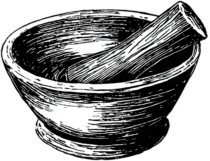
2♦ The Pestle & Mortar · Preparation
A pestle and mortar was how a cunning man or woman turned raw plants into medicine, alone, with one tool in each hand. The mortar held the plant steady. The pestle ground down into it. Neither did anything on its own, but together they took what went in whole, root, bark, or leaf, and brought it out crushed fine enough to steep in ale, boil into a decoction, or drink outright. The grinding itself was part of the cure, not just a step before it.
The herbs were not picked at random. Cunning folk followed herbalists like Nicholas Culpeper, who held that bay was the strongest of all: it “resisteth witchcraft very potently, as also all the evils old Satan can do to the body of man.” An affliction was rarely just an illness. Something had caused it, and the right herb, properly prepared, was believed to fight that cause directly, not only ease its symptoms.
Named remedies survive from across the country. Ursula Kemp, the Jack of Diamonds, steeped three leaves each of sage and St John’s wort in ale. William Brewer, the Jack of Clubs, made a decoction of dried bay leaves and peppermint. One Exeter cunning-woman claimed her own medicine was made from eighteen ingredients at once, liquorice, alder and rum among them. Joseph Blagrave, a Reading physician, distilled marigold, rosemary and angelica together.
Everyone reached for something slightly different. Everyone ground it fine before they trusted it to work.
Nothing was ready until the grinding was done.
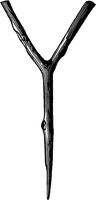
2♣ The Divining Rod · Finding
A divining rod was a forked branch, often of hazel, held loose, one arm in each hand. Walked slowly over ground believed to hide something, water, metal, or buried treasure, it was said to dip and pull downward on its own the moment it closed the gap between the person holding it and whatever they were looking for.
Richard Kitch believed treasure lay buried somewhere in Bridgwater, Somerset, and went looking for someone who could confirm it and find it. He first consulted a cunning-man named Old Leigh, who heard the report, agreed it was probably true, and sent him on to someone better suited to the actual finding: a cunning-woman named Anne Kingsbury. Kingsbury took up the search herself, working her rod over the ground of a house on St Mary’s Street until it answered her.
She said she had learned the method from William Lilly, the country’s most famous astrologer, and the claim held up. Decades earlier, in 1634, Lilly had worked hazel rods himself, in public, in the cloisters of Westminster Abbey, on a treasure-hunt organised with the King’s own clockmaker.
One man’s search, passed from hand to hand until it reached someone who could actually answer it, and a branch of hazel that closed the last gap on its own.
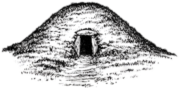
2♠ The Barrow · Spirit Counsel
A barrow was an ancient burial mound, and cunning folk believed it was one of the surest places on earth to reach a spirit. Not by chance, on purpose, at a set hour, with the right preparation made first.
In 1566, a Dorset cunning man named John Walsh described exactly how it was done. He went up onto the hills, to the great heaps of earth raised there long before his own time, and waited for noon or midnight, the only hours the spirits would answer. He carried a book with circles drawn in it, and at the mound he set two candles of virgin wax crosswise on the ground. By that light, inside that circle, he raised the spirit and asked it what he needed to know.
Another cunning man, from the north of England a generation or so later, kept the same kind of visit going for years. He went to a particular hill whenever he needed help, knocked on it three times, and said, “I am coming, I am coming.” The hill opened onto a great hall, where a queen received him and had her attendants give him a box of white powder, a few grains enough to heal the sick. When the powder ran low, he went back, knocked three times again, and was let in the same way.
Nothing about either visit was casual. The ground had to be the right ground, the hour or the words had to be exactly right, and the mound gave up nothing until they were. Get any part of it wrong, and nothing happened at all.
A barrow answered only those willing to meet it on its own terms, and not before.
The Threes — The Charm
The cunning craft as minor magic.
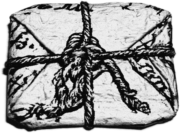
3♥ The Love Charm · Rekindling
A love charm was not always for winning someone new. Just as often it was for a marriage already made, gone cold, and wanted back. Cunning folk sold a written charm for exactly this: words set down on paper, folded small, sealed, and carried against the body until the feeling it named came back.
In Oldham, a woman named Sarah Ann Tomlinson learned from a cunning man called Clayton Chaffer that her husband had been unfaithful for six years. Rather than let her leave him, he sold her a charm for seven shillings, sealed with different coloured wafers, to be worn next to her heart under her stays. She was to put herbs in his tea besides, and burn his urine in the fire while saying the Lord’s Prayer. He promised to make him one of the best of husbands, as he had done, he said, for scores before her.
Some charms were not bought once but rented. A Newcastle cunning man named Peter Banks drew up magic leases binding a husband to good behaviour, the way a landlord binds a tenant. A woman named Jane Crossby paid ten shillings and two new shirts for one, and for a year her husband was loving and kind. When the year ran out and she let the lease lapse, he turned ill and untoward again, exactly as before. The charm was never a cure taken once. It was a precaution, renewed on schedule, or it stopped holding.
England’s own law took the whole business seriously enough to name it outright. The 1542 statute against conjuration and witchcraft named only three crimes worth the gallows: hunting for buried treasure, detecting a thief by magic, and provoking any person to unlawful love. Decades before that law existed, a widow in London had already gone looking for a cunning man to win her a rich husband, and another woman had already been hauled before the courts for the books she kept to brew love potions from. Getting a heart back, it turned out, needed just as careful tending in the eyes of the law as it did on the page.
The lease always ran out eventually. The trick was renewing it before anyone noticed it had.
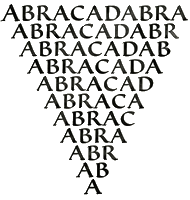
3♦ The Abracadabra Charm · Diminishing
Abracadabra was written eleven times, once for each letter, and every line after the first lost one more letter than the line before. By the last line, nothing was left. The word had disappeared off the page entirely, and whatever illness it had been written against was meant to disappear along with it. Worn folded around the neck against the first sign of a fever, it was one of the oldest preventions on record, taken up before the sickness could properly take hold.
A Roman physician named Quintus Serenus Sammonicus prescribed it centuries before England existed as a nation to write for: fold the word into a papyrus cone, wear it on a thread, and the fever would shrink as the word did. The instruction crossed a thousand years and a language without losing its shape. Reginald Scot recorded it plainly in his own time: written on paper with the proper figure and hung about the neck, it helped the ague. During the plague years of 1665, Londoners wore it and pinned it to their doors in triangle and pyramid form, hoping the same shrinking trick would work against something far worse than a fever.
By 1850, a Lincolnshire cunning man named William Martin of Bratoft was still selling it, though not entirely in earnest. He took ten shillings from a man named Tobias Davison, whose wife was unwell, and handed over a little parcel. Opened before the magistrates, it held the word, the twelve signs of the zodiac, and a rhyme so cheerfully irreverent that the court plainly wondered whether Martin believed a word of what he was selling.
Whether the seller believed it hardly mattered to the buyer. What mattered was catching the trouble early enough that eleven lines were still enough to finish it.
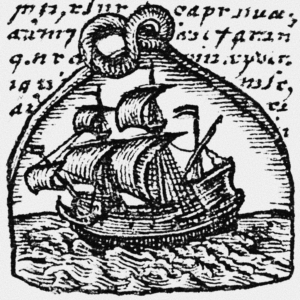
3♣ The Luck Charm · Tipping the Odds
Luck, in a fishing town, was not something you simply hoped for. It was something you went and bought, before every voyage, the same way you’d buy rope or salt fish. A cunning-man’s charm did the asking on your behalf, in words plain enough for anyone to understand: “I charge you and all of you, in the high sword name, to assist and blesse Cuthbert Burrell belonging to [his ship] from all rocks and sands, storms and tempests thereunto belonging, for this yeare.” Cuthbert Burrell paid to have his own luck spoken for, by name, for the year ahead.
It wasn’t only sailors, and it wasn’t always tied to an object at all. One Tudor magician, already paid handsomely to build a nobleman a gambling ring, charged nearly £8 up front for something separate first: “various spells for luck” at the gaming table, no ring, no charm to carry, just the luck itself, sold outright. Twenty shillings, or eight pounds, or whatever the trade could bear, luck had a going rate.
It wasn’t only the professionals, either. Among Lancashire farmers, buying cattle without the seller handing back a small coin “for luck” was asking for trouble. One farmer, well into his eighties, remembered doing it just the once as a young man, forgetting to ask for the coin back. The cow was found dead in the field not long after. He never went without it again, not for fifty years.
Nobody waited for their luck to turn. They went and asked for it, or paid for it, or simply refused to close the deal without it.
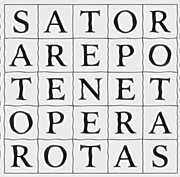
3♠ The SATOR Square · Warding
SATOR, AREPO, TENET, OPERA, ROTAS. Five words, arranged in a grid, and however you read them, forward, backward, top to bottom, bottom to top, they come out exactly the same. Cunning folk scratched the square into walls, wrote it on paper worn folded against the skin, and carved it into wood, always before trouble arrived rather than after, because a shape with no weak side and no way in has nothing for harm to grab hold of.
A Somerset charm from the end of the nineteenth century opened with the square as its very first line, before running on into a string of divine names for good measure. Cornish cunning-folk wrote the same square on parchment, folded small, for the same protective purpose. The square itself is far older than either of them: it turns up scratched on Roman wall-plaster at Cirencester and on a broken pot in Manchester, and in 1614 someone carved it into an oak board and fixed it to the wall of the parish church at Great Gidding, in Cambridgeshire, where it stayed. One example survives today in a museum’s own collection, incised on slate, kept for exactly the reason it was made: to overcome danger and difficulty before either had the chance to properly arrive.
Reginald Scot’s Discoverie of Witchcraft, printed in 1584, did more than any other book to carry charms like this one out of private hands and into wider English use. Whatever Scot himself thought he was exposing, the effect was the opposite: readers came away with the very formulae he meant to debunk.
Nothing in the square points a way through it. That was always the whole idea.
The Fours — The Foundation
That which should be consulted.
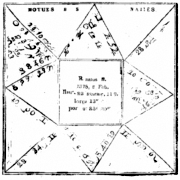
4♥ The Nativity Chart · Destiny
A nativity chart mapped the sky at the exact moment of a child’s birth, the planets fixed in position for that one instant and never again. Cast properly, it did more than predict a life. Read afterward, it could explain what had already gone wrong with one.
In 1795, a Chichester mathematician and astrologer named James Hallett advertised himself as “the original curer of all diseases” and offered nativities cast specifically “for the cure of witchcraft.” His handbill, printed with an engraving of himself seated among the tools of his trade, promised that the same chart used to foretell a life could be read backwards too, to find the moment misfortune had entered it.
Simon Forman, this deck’s own King of Clubs, cast nativities among the thousands of charts he drew up each year. Most were cast for the instant a client’s question reached him, but when the event in question was a birth rather than a question, the method held: a chart fixed to one unrepeatable moment, read for everything it could tell. The same skill served ordinary business too. Calculating a nativity could settle whether a venture would prosper, when a marriage should take place, or where stolen goods had gone, a trade John Steward and John Vaux were both still running a century apart.
By 1600, the skill had become the very measure of learning itself. “Nowadays among the common people,” it was said that year, “he is not adjudged any scholar at all, unless he can tell men’s horoscopes, cast out devils, or hath some skill in soothsaying.”
Once cast, the chart did not change. What it showed had already happened. The only choice left was what to do with the knowledge.

4♦ The Measuring Cord · Accuracy
In 1566, a Cambridgeshire cunning-woman named Elizabeth Mortlock explained exactly how she diagnosed a case of fairy-affliction. She prayed first, five Paternosters and five Aves, then measured the sufferer’s own girdle from her elbow to her thumb. If the person had truly been “haunted with a fairy,” she said, the band would come up shorter than it should, “and her cubit will reach further than commonly it doth.”
Girdle-measurers were recognised as their own kind of specialist, distinct from cunning-folk and charmers both, credited with the power to tell whether someone was bewitched or troubled by fairies simply by measuring the fluctuating length of a belt. The practice was already old by Mortlock’s time and would not survive much past the eighteenth century, but for two centuries it gave a wasting illness something a family could actually watch shrink and grow.
The method kept changing hands. In 1590, a woman named Mistress Bolton was hauled before the York church courts for measuring a girdle, and confused the judges so thoroughly they could not decide whether she counted as a charmer or not. Unlike Mortlock, she wrapped the band directly around her patient rather than simply holding it. Two years later, Matilda Allin was doing the same with kerchiefs and other lengths of cloth, and had widened the practice further still: not only sick people came to be measured, but sick swine.
Once the band came up short, there was no arguing with it. The measurement did not lie, whatever it turned out to mean.
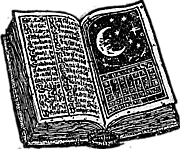
4♣ The Almanac · The Right Day
Cunning folk did not compete with the almanac. They kept one, alongside the ephemeris and the herbal, a printed reference to work from rather than calculate fresh for every client.
A Lincolnshire cunning-man examined by a magistrate in 1695 could barely read or write, “understood no Latin, nor no art or science, nor could scarce spell words right,” yet he kept several almanacs and a book on mathematics prominently on display. Whether or not he could really use them, their mere presence was enough to convince his clients he held knowledge they didn’t.
Others went further and published their own. The astrologer Sarah Jinner ran her own practice and folded it straight into print, including in one of her almanacs a remedy for impotence she attributed to a witch’s curse, the same advice she might otherwise have sold across a table. Better-known practitioners like William Lilly drew up astrological figures for individual clients investigating suspected witchcraft, the identical skill that filled a printed almanac’s pages turned to one person’s particular trouble.
The stars did not change depending on who was asking. Printed for everyone or drawn up for one, the method held.

4♠ The Spell Book · Guidance
Not every cunning person’s book was learned Latin ceremonial magic. Many kept something plainer: a single manuscript, added to over years, meant for their own eyes and one chosen apprentice’s, never printed at all.
Arthur Gauntlet, a cunning-man working out of Gray’s Inn Lane in London through the 1620s and 1630s, kept exactly this kind of book. His circles were cut wider than the standard nine feet found in other grimoires of the time, fourteen feet across, and where most conjurors favoured a sword, Gauntlet worked almost entirely with a wand. Small, deliberate departures from the books he’d copied out of, the mark of someone who had actually used the thing, not just owned it.
He worked with a skryer named Sarah Skelhorn, who saw angels crowding every room of a house until she grew tired of them, and called them to her crystal with her own private words: “Oh ye good angels, only and only, &c.” The astrologer William Lilly, who knew them both, thought little of Gauntlet himself, “a very lewd fellow,” but had nothing but admiration for Sarah, “the best eyes for that purpose I ever yet did see.” When Gauntlet died, Lilly bought his books outright and sold them on to his own pupil. Rare notions, he said, worth having.
Not every book came from years of use, either. In 1856, a Staffordshire cunning-man named James Tunnicliff told a client plagued by witchcraft that the only cure now required a proper spell-book, and that he would have to send to London to get one.
Whoever held the book held the method already solved. The only decision left was whether to follow it, or write one of their own.
The Fives — The Wound
Harm.
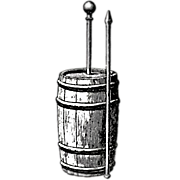
5♥ The Soured Churn · Disruption
Cream that sat in the churn for hours, worked and worked, and never turned to butter, was not read as bad luck. In a farmhouse kitchen it was an attack, and the household usually had a fair idea of whose door needed knocking.
At Upleatham, on the North Riding moors, Hannah Rothwell’s butter had refused to come for three weeks running, and her neighbour Mary Parker’s cow had gone dry at the very same time. The two women walked over to see Jonathan Westcott, the district’s wise man, who named the cause straight away, a local woman called Peggy with a known grudge, and set Hannah a cure that left nothing to guesswork. The churn was scalded through three times over, first with salted water, then with water boiled with rowan berries, then with plain water again, and two rowan pegs driven into either end. On the last filling, turning the churn nine strokes between each line, she said over and over, “This tahm it’s thahn, t’ next tahm it’s mahn, an’ mahn foor ivver mair.” Only then did the butter come.
Other counties kept their own methods for the same complaint. A hot iron dropped straight into the churn did it in Lancashire, a crooked sixpence in Northumberland, and in Cleveland it took two pinches of salt, one thrown into the churn and one into the fire, nine times over. Whatever the county, the churn was one of the last places cunning folk had steady work. Thief-finding and love charms faded from most of their trade generations earlier, but a stubborn churn was still bringing a wise man or woman to a farmhouse door well into the twentieth century, right up until the churns themselves went out of use.
Nobody argued with a churn that had been put right. They just went back to churning.
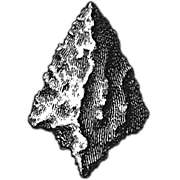
5♦ The Elf Shot · Affliction
A worked flint arrowhead does not belong in a freshly turned field, not one shaped and finished like this, and whoever struck it with the plough rarely thought it had landed there by chance. It was named on the spot: elf-shot, proof that an illness with no visible cause had a cause after all, small, sharp, and already spent.
At Bowness-on-Solway, on the Cumberland coast, the Bishop of Carlisle was shown a handful of them in 1712, kept in a house near the shore. His hosts would not part with a single one. Cattle that sickened without warning were elf-shot, they told him, and the arrowhead itself was the only proven cure, touched to the animal or steeped in water for it to drink.
The idea was old long before that visit. An English charm against a sudden violent pain names three unseen attackers who might be to blame, gods, elves, witches, and treats the wound without ever settling which one fired it. Six centuries later, a woman confessing to witchcraft in Scotland described the devil shaping elf-arrows with his own hands and passing them on for exactly this purpose. The words changed. The shape of the fear did not.
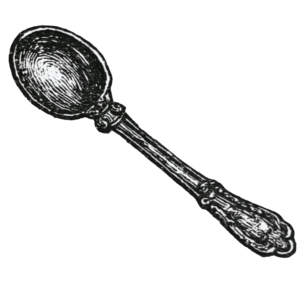
5♣ The Lost Spoons · Entrapment
Mabel Gray of Westminster lost the only spoons she owned in 1637, and her friends, wanting to help, sent her somewhere no respectable woman went alone: the worst parts of London. That was where the people who could find things were said to live.
She went first to a cunning woman in Southwark, who heard her out and passed her straight on to a cunning man on Lutners Lane. Mabel paid him a shilling in coin and a shilling in drink for his trouble. He did not send her home with a cure, he passed her on to someone else who could help. He walked her south past Fleet Street and deeper into the city’s worst quarter, to Ram Alley, a stretch so overrun with thieves and debtors seeking sanctuary that it was known simply as a place of evil reputation, and there handed her on to a third man, one Mr Tunn. That is where the record leaves her: two fees paid, two strangers deep into a district built for hiding, and still no spoons.
She was not the only one led on by a recommendation that went nowhere. A widow named Margaret Geffrey once handed over the only property she owned to a neighbour who promised to find her a cunning man on her behalf. He found none, and it took a lawsuit to get her own goods back. Losing a spoon and going to a cunning woman about it was so recognisable a situation that Elizabethan audiences watched it play out as comedy: in John Lyly’s Mother Bombie, a servant girl asks the title character who stole her silver spoon from the buttery, and is told it was never stolen at all, only mislaid, somewhere she would rather not admit to. On stage, at least, the cunning woman always has an answer.
Every step of Mabel’s path cost her something. As far as we know, none of them ever brought her spoons any closer.
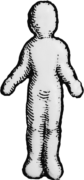
5♠ The Wax Figure · Manipulation
Eleanor Cobham was Duchess of Gloucester, married to Humphrey, the king’s own uncle and, since the young Henry VI had no children of his own, next in line to the throne after him. By 1440 Eleanor was forty and more than a decade into that marriage without a child of her own, her safest years for bearing one now behind her. She turned to Margery Jourdemayne, this deck’s own Queen of Hearts, who had already been supplying her with love charms since before the wedding, and asked for something stronger. Questioned later by a panel of bishops, Eleanor admitted what it was for: to “have borne a child by hir lord, the duke of Gloucestre.”
Around the same time, two men in Eleanor’s own household, her physician Thomas Southwell and an Oxford scholar named Roger Bolingbroke, had cast a horoscope for King Henry VI and read in it that he would fall dangerously ill within the year. That was not an innocent thing to have predicted. Because Humphrey stood to inherit the throne if the king died, anyone close to Humphrey’s wife foretelling the king’s death looked less like astrology and more like a wish, or worse, a plan. Southwell and Bolingbroke were arrested. And when the investigation turned up Margery’s wax figure, made for Eleanor, it stopped being read as a fertility charm and started being read as part of the same plot: an image shaped, so the accusation went, to waste away as the king’s own life waned with it.
The three of them paid for it unevenly. Southwell died in the Tower before his sentence could be carried out, probably by his own hand. Bolingbroke was hanged, drawn and quartered, his head set on London Bridge and his limbs sent to four English cities. Margery, the only one of the household with no rank to protect her, was burned alive at Smithfield. Eleanor herself, protected by her title, was spared execution and sentenced instead to public penance and life imprisonment.
Historians still argue about what that image was actually for. Some read it exactly as Eleanor herself did: a fertility charm, wax shaped and warmed to help a marriage bear fruit. At least one reads the very same object the other way entirely, as something meant to harm a king, not help a duchess conceive. Nearly six hundred years on, nobody who never saw the thing has managed to agree on what it meant.
It was not the only wax figure whose purpose got argued over. Decades after Margery’s death, a small wax doll turned up in England with the name “Elizabeth” scratched into it, and given who sat on the throne by then, some feared it was aimed at the queen’s own life. Not long after, a play called Fedele and Fortunio, performed for Elizabeth herself, acted out how such a doll was really supposed to work: pricked or held to a flame to make somebody fall in love, not to kill anyone. Nobody could prove which one that doll had actually been for either. The method itself was already old even in Margery’s day. Back in 1324, two men shaped wax images of King Edward II and spent months sticking them with pins in a house outside Coventry, a plot to kill a king by wax that predates Margery’s own case by more than a hundred years.
What the figure was made to do and what it was found to mean were never the same question.
The Sixes — The Remedy
The cunning craft that sets things right.
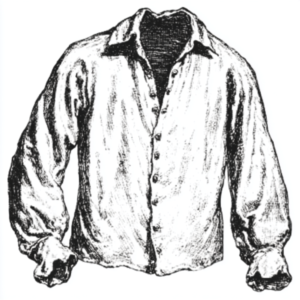
6♥ The Cleansed Shirt · Mending
Joan Squyer lived near Canterbury, and in 1474 she admitted to something she had already been telling her neighbours to try for themselves: she had taken holy water from her own parish church and washed her husband’s shirts in it. Nothing else changed. She gave him no potion, spoke no charm over him, confronted him with nothing. He simply grew, in her own words, “humble and obedient to her will,” and stayed that way.
Church officials heard about the theft and were not amused by it. Squyer was made to perform public penance for taking what belonged to the church, whatever good it had done her marriage. Whether her neighbours took the method up anyway, once she had shown them it worked, is not recorded.
Hers was not an isolated case. A Canterbury diocesan court book of the same period logs another instance from the same decade, a woman using holy water for the identical purpose, husband’s obedience secured with nothing more than washing. Elsewhere in the same run of church-court cases, other women were buying charms to carry against their skin or renewing yearly contracts with a cunning man to keep a husband’s temper sweet, paid for in coin and shirts of their own. Against those, Squyer’s method cost her only what she could take unnoticed on a Sunday.
No confrontation, no bought spell, no credit claimed. The man wearing the shirt never worked out why he had softened. He only knew that he had.
6♦ The Drawn Breath · Relief
An illness could be drawn whole out of a suffering body, if the healer was willing to take it into her own. In Northumberland in 1653, a child fell sick with something no one could name, and Margaret Stothard put her own mouth to his and sucked the sickness out with her breath. The chirping and sucking noises she made were loud enough, and strange enough, that the boy’s own mother stood by convinced Stothard had sucked her son’s heart clean out of him along with whatever ailed him.
The going rate for a cure like this was a penny, the standard fee owed a charmer for her trouble. Stothard was offered exactly that and took something else instead: a fleece of wool, handed over in place of coin. It was common enough for cunning folk to be paid this way, in wool, in eggs, in whatever a household actually had to spare, and no less binding a payment for it.
Nothing about the method was gentle. Nothing about the fee was fixed either. Between them, the cure and the wool tell the same story: relief could be bought, but not always in the currency you expected, and not always without a cost to the person willing to take it on.
6♣ The Horseshoe · Expulsion
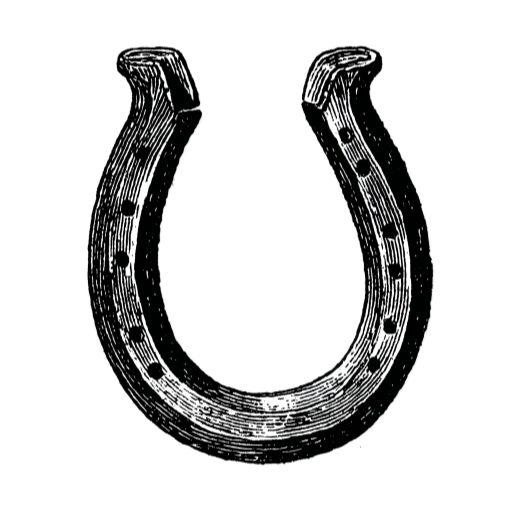
A horseshoe is iron, and iron has always been trusted to turn evil away. Joseph Blagrave, a Berkshire astrologer-physician who spent much of his career diagnosing witchcraft as the cause of illnesses doctors couldn’t otherwise explain, prescribed two of them for a sufferer past the point of simple warding. The first was heated red-hot and quenched in the patient’s own water, then nailed straight into the inside of the threshold with three nails, heel end pointing up. The second went into the same water once it was set over the fire with a trivet, horse-nails and white salt added, quenched in it again and again until the whole lot boiled away to nothing.
The horseshoe was never a lone remedy. It sat inside a whole catalogue Blagrave kept of rituals for exactly this purpose, rules for making the affliction travel back to whoever had sent it. Elsewhere in the same section he describes burning thatch or roof-tile soaked in the patient’s water and white salt, timed to the phases of the moon, the smoke and ash doing to the absent witch what the horseshoe did at the door. His own explanation for why any of it worked: the patient’s blood and water carried something of their vital spirit, and a witch’s magic could never be worked on a body without a trace of the witch’s own blood mixed into it. Burn that trace, and the witch burned too.
Blagrave’s own patients were not the only households doing this. Up in County Durham, farmers nailed a horseshoe over the stable door specifically to stop witches riding their horses ragged in the night, a defence one correspondent’s own family still kept up, paired with a sprig of broom hung over the rack for good measure. Yorkshire households did the same at their own front doors, plainer protection than Blagrave’s aggressive counter-strike, and held that any maiden lucky enough to find three horseshoes in a single year, thrown one by one over her left shoulder, secured herself, and later her own children, against ever being witch-held at all.
Nailed quietly over a stable door or boiled down to nothing in a sickroom, iron did the same job everywhere it hung. Get it out, and keep it out.

6♠ The Pierced Heart · Repaid in Kind
Sticking a heart full of pins and burning it was, by one Yorkshire witness’s own account, “perhaps the most widely adopted anti-witch charm” going, worked at midnight behind closed doors and windows, in absolute silence, with no one let in until it was done. Whatever had caused the trouble was expected to feel every pin.
In 1843, Charlotte Horn of Plymstock went looking for help for her mother Ann, who had been ill for some time, and found it in Agnes Hill of Plymouth. Hill’s cure came with a shopping list: fasting water, a live cock, and ash wood gathered from three separate parishes. Once everything was assembled, Ann cut the cock’s throat herself, over an earthen pan already holding the fasting water, letting the blood mix in. Hill cut the bird open and drew out its heart, then told Ann what to do with it, stick it with new pins, new needles, and blackthorn prickles, and hang it to roast before a fire built on the ash wood they’d carried in. When it was done, heart, pins and needles together went into the flames.
Witchcraft was never named outright, not once, but everyone involved understood exactly what they were fighting. Hill’s other remedies for the household ran just as far, whole pieces of Ann’s own furniture burned on her instructions. Word got out. The Plymouth court fined Hill for it, and by the time the case was over she had to flee the courtroom to escape a furious crowd waiting outside.
Devon was nowhere near alone in it. In Yorkshire, a farmer named William Dawson used the same remedy on a beast’s heart, nine new nails, nine new pins and nine new needles driven in, then burned on a rowan-wood fire at midnight to answer a run of cattle deaths. Somerset kept the practice going through the 1880s and 90s, sheep and pig hearts pierced and burned the same way at Ashbrittle, Staplegrove, a Wellington workhouse, and East Quantoxhead, four separate cases inside twenty years. One of the actual hearts survives: a sheep’s heart bristling with iron nails and steel pins, collected in South Devon by Edward Lovett and bought by Oxford’s Pitt Rivers Museum in 1911, still catalogued and kept.
Whatever had taken hold of that house in Plymstock, it was answered exactly as it came, measure for measure, right down to counting out the pins. The same reckoning was being made in farmhouses and workhouses the length of the country, in whatever heart came to hand.
The Sevens — The Sacred
The influence of the divine.
7♥ The Psalm · Intercession
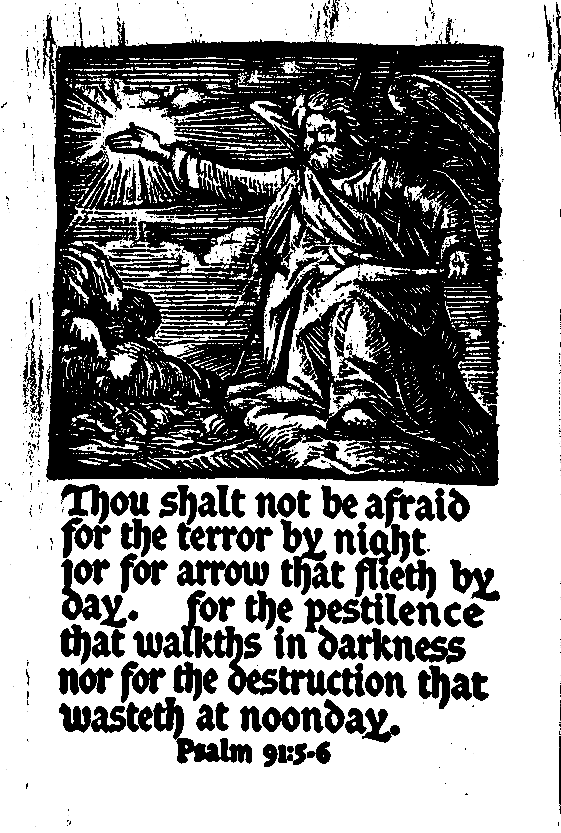
Cunning folk never pretended to work outside the church’s own authority. Many borrowed it outright, reading psalms and prayers aloud as part of a cure, or setting their clients to do the same. One Yorkshire cunning-man prescribed a bewitched patient a fixed course of scripture: Matthew’s tenth chapter and Psalm 70 read together, then Deuteronomy’s twenty-eighth chapter read over seven times, always at eleven at night. Clients rarely saw this as borrowed authority at all. One of a clergyman’s own rustic witnesses insisted a local cunning-woman “did more good in one year than all these scripture men will do so long as they live,” and a Cornish vicar complained that even his most churchgoing parishioners believed only Scripture words, or words just as good, ever went into a real charm.
Reading scripture aloud was one way to use it. Writing it down and hiding it was another, and one particular Latin charm had an unusually long life. Reginald Scot printed it in 1584: a line from St Luke’s gospel stitched to a line from Psalm 68, “Let every spirit praise the Lord: they have Moses and the prophets: Let God arise and his enemies be scattered.” His own instruction was to write it on virgin parchment and hang a copy in each of the four corners of the house.
The charm outlived him by centuries. A popular chapbook, sold as a “night-spell to catch thieves” and falsely credited to the astrologer William Lilly, carried the same Latin into print shops in Newcastle, Warrington, and Coventry, running through at least eleven editions in Newcastle alone. A Nottinghamshire cunning-man was still handing a version of it to a client in 1866, sold as protection against witchcraft. Both the chapbook and Scot’s own text agreed on where it belonged: the four corners of the house, garden, or orchard.
One household went further. Around 1900, a farmer near Pendle, in Lancashire, kept his own copy, the Latin worn down to near nonsense by whoever had copied it out in an unpractised hand. He had moved it from the corners to the doorway itself, tucked into the gap above the frame, doing its work quietly on everyone who passed beneath it. He kept a second copy for the fields, with one line added: a plain command that the cattle there should prosper. When an old cow-house in neighbouring Yorkshire was pulled down around the same time, more copies of the same charm, garbled further still, turned up tucked into holes above the stalls, standing guard over animals rather than people.
The doorway itself drew more than one kind of charm. Near Burnley, another household kept a written protection over its own door with no scripture in it at all, just the planets and the astrological aspects named one after another, “Sun, Moon, Mars, Mercury, Jupiter, Venus, Saturn, Trine, Sextile, Dragon’s Head, Dragon’s Tail,” charging them to guard the house from evil spirits and keep the family in health and wealth. Whatever filled the paper, the gap above the door was where people trusted it to work.
Whoever had written it down never had to stay and watch it work. Three hundred years and half the country later, the scripture was still doing that on its own.
7♦ The Blessed Ring · Many Hands
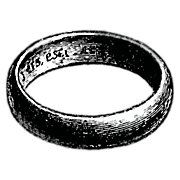
Once, only a king could do this. Every Good Friday from the reign of Edward III to that of Mary Tudor, the monarch blessed a plateful of gold and silver rings at the altar of the Chapel Royal, rubbing them between royal fingers said to carry the same healing touch that cured the King’s Evil. Given freely, without money or petition, they were believed to cure epilepsy, cramp, and palsy in whoever wore one after. When Elizabeth’s reign ended the custom, the cure did not end with it. People simply began making the rings themselves.
A farmer travelled from village to village near Ilsington, in Devon, collecting sixpences, one from each of seven unmarried women in seven separate parishes. His son had suffered for years from “the falling sickness,” and medicine had done nothing for him. Someone had told him the coins had to pass through seven hands before a silversmith could melt them down into a ring, and the boy would have to wear nothing else. He didn’t know how many miles he’d walked collecting them by the time he reached the last house on his list, only that he meant to finish.
The method varied by county, but the principle held everywhere it was practised. In Yorkshire, the coin had to come straight from the church collection: the Vicar of Danby, near Whitby, was once asked by one of his own most respectable parishioners for a halfcrown taken from the plate, thirty pence tendered in exchange, so it could be reforged as a ring for an epileptic relative. A Lincolnshire account-book from 1754 records a poor woman at Barton paying towards “a silver ring” for her fits. Rings made the same way, from money blessed by passing through the church, were still being worn against epilepsy in the Forest of Dean when this custom was first written down. Hereford had its own version by the mid-seventeenth century, Berkshire by the eighteenth. In Cheshire, the shilling came from twelve pennies begged from twelve people of the opposite sex to the sufferer. In Suffolk, no coin was melted at all, twelve scraps of broken silver did the same work.
None of it worked by the metal alone. What did the work, in every version of the story, was the money’s journey first, through a church collection, through a chain of strangers’ hands, through whatever passage made it belong to something larger than the person who carried it afterward. A commoner’s ring, made by begging round a parish, was doing in miniature exactly what a king had once done at the altar of his own chapel.
Some cures don’t come from your own hand. They come from what the coin passed through on its way to you.
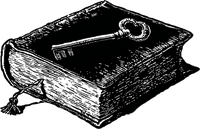
7♣ The Bible & Key · Honesty
Write a name on a scrap of paper. Slip it into the hollow barrel of a house key. Lay the key across a chosen verse of an open Bible, bind the whole thing shut, and balance it on two fingers. Read the verse aloud over the name, and wait. Nothing. Draw the paper out, feed in the next name, read the verse again. Somewhere down the list, book and key will turn together, of their own accord, and that is the name you wanted.
In 1549, a London cunning-man named William Wycherley was called on to find a thief in the King’s own slaughterhouse. A woman’s purse had been picked of ten shillings, and the household’s suspects were written out for him name by name. He put each one, in turn, into the hollow barrel of a key, laid the key on a chosen verse of the psalter, and read the verse aloud over it. At one name, a woman’s, the book and key turned round together. He never claimed anything mystical about the gift itself, only that he had done it so many times he could no longer count the occasions, and that people pestered him for it daily. Reginald Scot, writing a generation later, described the very same technique down to the wording, names “orderlie put into the pipe of the keie” until the guilty one made the book fall from the fingers holding it, proof this was no private trick of Wycherley’s but a known and trusted method. In the same set of examinations that caught Wycherley out, another practitioner turns up doing much the same thing under a different name: Sir Robert Bryan of Highgate, a former hermit turned priest, who worked the sieve and shears for some clients and the psalter and key for others, calling on Saint Paul and Saint Peter as he went.
The method outlived them both by centuries, though later hands found a shortcut. Rather than feeding in name after name, most later practitioners tied the key into the book just once and simply spoke a suspect’s name aloud, trusting the same shiver of movement to answer. A Gloucester vicar worked it this quicker way in 1551, naming a servant, Margaret Greenhill, as a thief, tying the book shut with string in his own church chancel before the party went off to search her bed-straw. A London gentlewoman did much the same at home in 1704, a key balanced on her finger inside a closed Bible, murmuring a suspected maid’s name until the book turned in her hand. In 1832 it reached the Thames Police, when a Mr White and his neighbours hung a Bible and key from a nail, the fiftieth Psalm sealed inside, and pronounced a Mrs Blucher guilty by name, a verdict that ended in her marching round to beat Mrs White and a charge of assault. Not every verdict held. A Southampton collier accused a lad by the same method in the eighteen-sixties, and the magistrates threw the case out on the spot. As late as December 1878, a Ludlow court still heard testimony of the key jerking in its owner’s hands at the mention of a guilty name, the same ritual, the same result claimed, three hundred years after Wycherley first described it under questioning.
By the 1740s the ritual had drifted somewhere stranger still: a boarding-school, where no one needed naming at all. A girl suspected of theft was tried alongside her classmates with “the Bible and key, as was the custom,” each one holding it in turn, guilt read straight off a shaking hand rather than a turning book.
Any book might have carried the trick. The Bible carried an authority no other book in the house could match, and people went on trusting it to answer questions long after they had stopped being able to say why.
7♠ The Three Biters · Deliverance
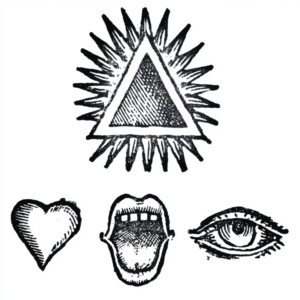
“Three biters have bit him, heart, tongue and eye; three better shall help him presently, God the Father, God the Son, and God the Holy Spirit.“
That is the whole of it. Twenty-six words said over a man who believed himself bewitched, with a little oil smoothed onto his skin, and nothing else required.
The charm names its enemy with a precision worth pausing over. The heart is the ill-will someone holds and never says. The tongue is what they do say, the bitter word let loose behind your back. The eye is the look itself, the glance that withers what it lands on. Between them they cover the whole anatomy of malice, everything a neighbour can do to you without ever laying a hand on you. And the charm’s answer is not to argue with any of it. It counts the enemy, three, then counts what is coming against them, three, and lets the reader work out which three weigh more.
The man who said them was a London practitioner named Robert Booker, and the year was 1622, but he did not invent a word of it. This was a standard formula. Copies survive in manuscript, tucked into commonplace books and quarter sessions papers, one of them written out by a Lancashire charmer questioned in 1634. Other cunning folk kept to the written version of the same idea. A Nottingham sorcerer called Groves sold his clients copies of St John’s Gospel as a preservative against witchcraft. A century after him, the cunning-man Richard Walton was writing out much the same thing on scraps of parchment, the opening of St John’s Gospel and many of the divine names belonging to God and his Holy Angels, ending with a request that the angel of God preserve the bearer from witchcraft or evil tongues. Walton’s charm was read out in court and misread there, taken for a spell to keep a horse-thief from arrest. He was bitter about it afterwards. If the gentlemen of the jury had read the thing properly, he said, they would have seen it only ever concerned witchcraft.
There was something quietly out of step about all of it. The Church of England had no place for this. When these charms turn up in a cunning person’s hands their Catholic ancestry is written all over them, in the Latin, in the Aves and Paternosters counted out in fives and fifteens, in the old assumption that holy words are things you can hold and carry and set to work. This was power from a religion the country had officially left behind, still doing business in back rooms two hundred years after the fact, because people had never stopped believing it was the strongest thing available.
What runs through every version is the same refusal to fight on the enemy’s terms. Somebody wished you harm, and the answer was never to wish harm back, never to hunt for who it was, never to send anything into the dark after them. The answer was to stand behind something that had never lost, and let it do the standing.
The Eights — The Turning
A desired change.

8♥ The Witch Cake · Reversal
A witch cake was made of two things: flour, and the water of the person who had fallen ill. It was baked on the household’s own hearth like any other bread, and never meant to be eaten. What made it a cure rather than a loaf was that it was made out of the patient. Whatever had got into them had got into it.
From there it could go one of two ways.
Laid back onto the body, it worked on the sufferer. In 1616 Edward Drake, of King’s Lynn, had a daughter sick in a way nothing had touched, and rode out to a cunning-man about her. This was no ordinary illness, he was told: the woman responsible would have consumed the girl’s heart, and much longer would put her past saving. The quarrel behind it had begun over a hen, which Drake had never heard in his life.
The instructions were exact enough to be printed the same year. Flour from the bakers, mixed with the girl’s own water instead of any other liquid, baked on the hearth. One half laid to the region of her heart, the other to her back directly opposite, so the two sat facing each other through her. An ointment, a powder and a written charm went on top. If she had not amended within six hours, there was “no health or recouery to be looked for.”
And say nothing to anybody, because the woman who had done this “would know any thing.”
Drake rode home. His daughter lay next door to Mary Smith’s, and as he came down off his horse Mary Smith was leaning over her shop window, watching him arrive. She cursed him as he passed, then told his daughter her father had been to see a wizard.
He had been told to keep it to himself. He had not yet got through the door.
Put in the fire instead, the same cake worked the other way about. It stopped being a medicine and became a summons. Whoever had laid the sickness on would feel the burning herself, past bearing, and come to find out what was being done to her. The remedy walked up the path and knocked.
In West Yorkshire, in 1683, a physician called Dr Thornton arrived uninvited at the house of Judith Higson, whose son had lain a long time in bed, swollen in the throat, unable to stir, looking, she said, as one affrighted. Thornton said it was no natural distemper: the boy had been hurt by an evil tongue. And he would prescribe nothing at all until the water had been tried by fire. Wheat meal, the boy’s own water, some of his hair worked in, and stumps of horseshoe, made into a cake and put on the fire.
Higson balked, though not at the strangeness of it. No words were to be said over the cake at all, and she thought a thing that worked without words might still be a charm. She walked to two ministers and asked. They told her it was no way of God, and sent her to fasting and prayer instead.
The fire was never lit. Nobody came up the path. What Judith Higson wanted from that cake was never really medicine: she wanted to stand in her own doorway and see who arrived.
8♦ The Cast-Off Stone · Casting Off
Nothing about the stone mattered. It was an ordinary pebble off an ordinary road, and there was no charm spoken over it and nothing written on it. What mattered was the counting. One pebble for each thing wrong with you, and the trouble went where the count sent it.
In Northumberland, a man with warts counted them, put that many pebbles into a small bag, and carried the bag to where four roads met. He dropped it there and left. The warts went with it.
Then the part that gives the charm its edge. The affliction had not been destroyed. It was lying in a bag on the ground, in working order, waiting. Whoever picked up the bag would get the warts.
The same charm turns up in the West of England, and in the North Riding of Yorkshire they made it stranger still: take a pebble from as many different graves as you have warts, tell nobody you are doing it, and throw the bag back over your left shoulder without looking to see where it lands.
It belonged to a whole family of English cures built the same way. Rub the wart with a black snail and hang the snail on a thorn, and the wart goes as the snail dies. Rub it with stolen meat and throw the meat away. Cut an apple, rub it, tie it shut and bury it. Cross the wart nine times with a new pin and fling the pin over your shoulder. Put the trouble into a thing, then get rid of the thing.
Francis Bacon set the whole principle down as a common experiment: taking away warts by rubbing them with something “that afterwards is put to waste and consume.” He believed it, he wrote, “the rather because of mine own experience.” A hundred warts, gone in five weeks, including one he had carried since he was a boy. Their going, he admitted, “doth yet stick with me.”
So somewhere, where four roads met, a small bag sat on the ground. And the worst thing anyone passing could do was wonder what was inside it.

8♣ The Mirror · Revelation
Cunning folk had a choice of surfaces to work with. A crystal, a bowl of water, a cup of ink, a well-polished thumbnail. Again and again they reached for a looking-glass instead, and it is not difficult to see why. A mirror is the only one of them that already has a face in it before anybody starts. The client came to it looking at somebody, and the only question left open was who.
In 1578 an Essex man went to a cunning man because someone had stolen his linen. He was taken into the hall of the house, where the cunning man hung a looking-glass up over the bench on a nail and told him to look into it. What he said next was carefully worded, and it survives in the deposition: as far as he could guess, the man should see the face of him that had the linen.
As far as he could guess. Not a promise. Naming a neighbour aloud could put a cunning man before the magistrates for slander, and handing over a glass could not. Whatever came up in it was the client’s own business.
Anne Bodenham worked outside Salisbury with a green glass held up to the sun, in which she said she could see a thief at their business wherever they happened to be. She found a lost gold ring that way, and a stolen spoon. Once she showed a servant girl a scene going on in a house miles off: a woman standing at a window with her hands tucked into her sleeves, other people drinking beer. The girl went home and found it had been exactly so. Bodenham turned clients away, too. One came on a day when the wind did not blow, nor the sun shine, nor Jupiter appear, and she said plainly that the glass would give her nothing.
Two centuries later, in Essex, a boy came to James Murrell about money gone from a box. Murrell told him not to worry: it had been taken for a purpose and it would be put back. Then he asked the boy to promise never to speak of it while the woman who took it was alive. The boy promised. Murrell had him look into a glass, and there he saw his own mother, on the hill nearby, carrying bundles of wood. The money was back in the box not long after.
Not everyone saw anything. Maria Giles worked at Newbury with a piece of glass backed in black. Her client Emma Gregory, a hawker who had been robbed, described the session to the Newbury magistrates. Giles “pretended she had brought him in the glass.” Gregory’s friend Ford looked first and said he could see himself, “and could discern someone else, but he could not say who.” Then Gregory looked, and the court asked whether she had seen the thief. “I could see nothing but myself.” She had not felt satisfied, she said, and she wanted to go.
A boy looked into a glass and saw his own mother. A woman looked into the same kind of glass and saw nobody at all.
8♠ The Hag Stone · Reprieve
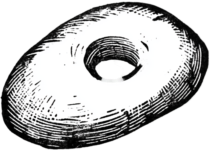
Nobody made it. A pebble with a hole worn clean through by water, picked up off a beach or turned over in a field. They were called self-bored stones, and that was the point of them: the hole had to have made itself. In the north-east they were adder stones, in the North Riding a lemmel-steean, elsewhere a witch stone or simply a holey stone.
What they were for was the night.
To be hag-ridden was to surface in the small hours unable to move, with a weight on your chest and the certainty that something was in the room with you. The earliest English mention of the stone comes in a charm against nightmares from the fifteenth century. Small ones went in a pocket or hung over the bed, and one from Exmouth was kept hanging on a bedstead for exactly that.
But the hag did not only ride people, and a horse could not tell you what had happened to it. You knew because you came out at first light and found the animal standing in its stall wet through and trembling, having been somewhere all night without ever leaving the building.
John Aubrey wrote it down in 1686. “In the West of England (& I beleeve, almost everywhere in this nation),” he said, “the Carters, & Groomes, & Hostlers doe hang a flint (that has a hole in it) over Horses that are hagge-ridden for a Preservative against it.” A Devon charm was more exact about it: eight holed stones on a string tied with five knots, hung up in the stable, and the pixies would not be able to night-ride your horses.
Two hundred years after Aubrey, a carter called Kimber, working for General Pitt Rivers at Rushmore in Wiltshire, nailed a holed stone to his own cottage door to keep the witches off. The stone is in a museum in Oxford now, and his name is still on it.
They spread well past the stable. At Whitby people tied small ones to their front-door keys to keep the household prosperous. At Weymouth the boatmen fastened them to their bows. In Brighton the women of the fishing families wore necklaces of little holed fossil sponges, sold along the front for luck.
Whatever the water had done to those stones, people trusted it more than anything they could have made themselves.
The Nines — The Power
The cunning craft as major magic.
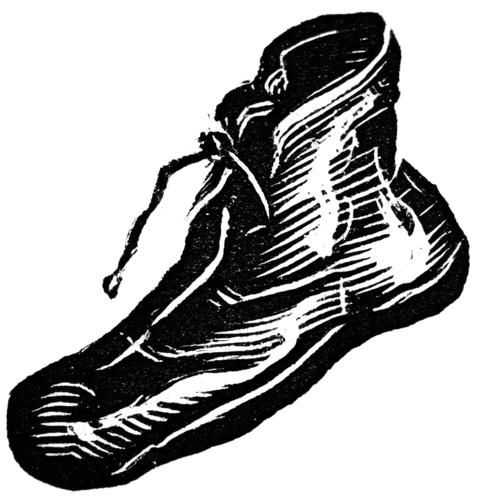
9♥ The Sin Eater · Unburdening
A loaf of bread was carried out of the house and passed across the body of the person who had just died. Everything they had done in their life went into the bread. Then a man ate it, and it was his.
In Herefordshire, John Aubrey knew of one living in a cottage on the Ross highway. When the corpse was brought out of the house and laid on the bier, the loaf was handed to him over the body, along with a maple bowl full of beer, which he was to drink, and sixpence. In return he took upon himself, there and then, “all the sinnes of the defunct, and freed him or her from walking after they were dead.”
In Shropshire they called him the old Sire, and word was sent to him as soon as anybody died. John Bagford wrote it down in 1714, within the memory, he said, of their fathers. The man came to the house and stood outside the door. Somebody brought him out a cricket, a low three-legged stool, and he sat down on it facing the door. They gave him a groat, which he put in his pocket, a crust of bread, which he ate, and a full bowl of ale, which he drank off in one draught. Then he stood up and pronounced, with composed gesture, the ease and rest of the soul departed, “for which he would pawn his own soul.”
He never went inside. That was the arrangement. He was fed at the threshold, took what he was given, and went, and the family carried on with the funeral of somebody who was now free to rest.
The last of them in England was not a beggar at all. Richard Munslow farmed at Ratlinghope in Shropshire, was comfortably off and well thought of, and seems to have taken the work up late in life. In one week in May 1870 he lost three of his children to scarlet fever. He died in 1906 and was buried in his own parish, and a century later the village paid to put his grave back in order and held a service for him.
Fourpence for a crust of bread, and a soul pawned to pay for it.
9♦ The Witch Bottle · Permanent End
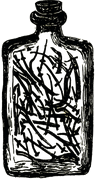
A witch bottle showed nothing from the outside. Sealed inside sat the sufferer’s own water, with pins, nails or needles dropped in after it and a little white salt. Corked shut and buried upside down at the threshold, it was made to work the affliction back onto whoever had sent it.
Joseph Blagrave, a Reading astrologer, printed the method as a plain recipe in 1671: “stop the urine of the Patient, close up in a bottle, and put into it three nails, pins, or needles, with a little white Salt, keeping the urine alwayes warm.” Leave it there long enough, he wrote, and it would endanger the witch’s life. They would be “grievously tormented making their water with great difficulty.”
Joseph Glanvil printed the fullest account, told to William Brearly of Christ’s College, Cambridge, who was lodging in Suffolk around 1640. His landlady had been ill a long time and could not sleep, haunted, she said, by a thing in the shape of a bird that fluttered close about her face. An old man who travelled up and down the country called in, told her husband it was only a dead spright, and set him a cure: bottle her water with pins and needles and nails, cork it fast, and stand it by the fire. The bottle began to joggle. He worked the fire shovel over it, on and off, until the cork bounced out and the urine and the pins and the nails flew up and went off with a report like a pistol. His wife was no better. It seems it was too nimble for you, said the old man on his next visit. Bury it in the earth instead, and that will do the feat. This time she recovered. Some while afterwards a woman walked over from a town miles away crying that they had killed her husband, a man they had never heard of. He had told her on his death-bed what he had done. He was a wizard, he had bewitched the wife of that house, and the thing in the ground had killed him.
In 2004 workmen in Greenwich turned up a sealed stoneware jar, still rattling. Opened later under laboratory conditions, it held urine that proved to be a smoker’s, along with sulfur, brass pins, clumps of hair, ten manicured fingernail clippings, and twelve iron nails, one driven straight through a small leather heart. It had been buried upside down, exactly as the books said, within a generation of Blagrave printing the recipe.
The habit outlasted the recipe. A small silvered flask, corked and sealed over with brown wax, was collected near Hove in 1915 from an old lady who explained it plainly enough. “They do say there be a witch in it”, she said, “and if you let him out there’ll be a peck o’ trouble”. It sits in Oxford now, still sealed.
9♣ The Sieve & Shears · The Guilty Party
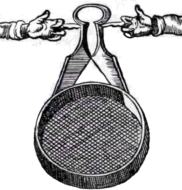
A pair of shears was driven into the rim of a sieve, the whole thing hung from the points, and two people held it up on their fingertips. Then the names were spoken. John Aubrey set the words down as a call and an answer, one side saying “By St Peter and St Paul such a one hath stoln it,” the other answering “By St Peter and St Paul he hath not stoln it,” name after name, until the sieve was said to turn in their hands and settle the matter.
It needed no skill and nothing you did not already own, which is why it turns up for so long and so far apart. In 1554 William Hasylwoode, a cleric of Hornsey, stood before the Commissary’s Court of London and explained himself. He had lost his purse with fourteen groats in it, and he remembered that when he was a child he had heard his mother say that when any man had lost anything, then they would use a sieve and a pair of shears to bring to knowledge who had the thing lost. So he hanged the sieve by the point of the shears and said the words, “By Peter and Paule, he hath yt,” naming the man he suspected. He had done it once in his life, he told them, and mentioned it to one acquaintance. He was given penance. Forty-four years later John Casson answered for the same thing before the Archdeacon of Nottingham after a wether went missing, saying he had tried it with his sister, once, without any ill intent. Casson had called on the Father, the Son and the Holy Ghost rather than the two saints. The words were interchangeable. What mattered was that something was invoked and the sieve moved.
In London it made reputations. William Wycherley, questioned in 1549, listed the men he knew who worked it, Thomas Shakilton of Aldersgate Street among them, who had “doon therwith many praty feates, and many trouthes tryed out.” Eighty-four years later a Worcester woman named Ann Bellett was up before the quarter sessions for “the evil art that she useth with the juggling trick of the sire and sheves,” calling on Peter and Paul, the court said, in profane manner. The formula had barely shifted in three generations. Neither had the charge.
The fullest account of it working comes from Castleton in Lancashire in 1641, where three women were examined. Alis Scholfield had learned to set the sieve and shears off Jane Brearley. It was held up on Jane’s finger and Mary Fielden’s, and Alis spoke what Jane could only describe as many strange words. Mary remembered them better: that if Samuel Greame did steal the hen, then St Peter said so, St Paul said no. The same two saints as Aubrey’s, worn down into a rhyme. The sieve turned about at the name, Mary said. It had already been asked who took James Newbold’s sheep, and while they had it in hand they asked it whether Mary and Jane were themselves with child. The hen, the record adds, had left the house in John Chadwicke’s breeches.
By the nineteenth century the whole practice had simply stopped. Nobody wrote down why. It was tried less, and then it wasn’t tried at all.
Whoever held the shears never had to say the guilty name themselves. The sieve said it for them, and everyone in the room understood exactly what had just turned.
9♠ The Toad Bone · Dominion
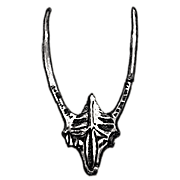
The bone was small and forked, a crotch bone, one of the bones of the pelvic girdle. A man who had one was said to be able to do anything he liked with any horse he met. There is a detail in it that nobody invented: the bone is the same shape as the frog, the horny elastic pad in the underside of a horse’s hoof. The thing taken out of the toad matched the thing already inside the animal it was meant to command.
Albert Love, born 1886, of Wortwell in Norfolk, told George Ewart Evans how it was got, and gave the whole business its name. He called it the Water of the Moon. The toads came from around Fritton, near Yarmouth, the sort with a ring about the neck that the horsemen called walking toads. They were killed and set on a whitethorn bush, and left there a day and a night until they dried. Then they went into an ant hill and stayed a full month, until the moon came round to the full again, and the ants left nothing but the bones.
Then the hard part. You took the skeleton down to running water at midnight, and you watched it. One bone leaves the rest and floats uphill, against the current, and that is the one you want. What you must not do is look away. That, Love said, is where the power comes from, keeping your eyes on that particular bone. And while the bones are parting you hear the trees and every noise you can imagine, buildings coming down, a traction engine running over you. Across East Anglia the same warning ran through every account of it: do this carefully, because the Devil is looking over your shoulder.
Love got two lots through. The third time there was a crackling in the noises, as if somebody had fallen, and it made him take his eyes off the water. He was plain about what that cost him. There was no answer, he said. The bone had no power. He wouldn’t answer.
What a bone that did answer bought was total. It was taken home, baked, dried and broken to powder, kept in a tin, or mixed with oil in a bottle and carried in the pocket. A little on the finger, wiped across a horse’s tongue, his nostrils, his chin and his chest, and, in Love’s words, he is your servant and you can do what you like with him. Other horsemen kept the bone whole instead, cured, wrapped in linen and hidden somewhere about the body. Touched in the pit of the shoulder a horse would stand and not move; touched on the rump he was let go again. One of them said a horse dealt with that way couldn’t pull a duck off its nest even if he wanted to.
Nobody sold these. A month of waiting, and one night of not looking away.
Sources:
2♥ The Love Potion
Owen Davies, Popular Magic: Cunning-Folk in English History (2003), p.1. Tabitha Stanmore, Cunning Folk: Life in the Era of Practical Magic (2024), Ch.2. Tabitha Stanmore, Love Spells and Lost Treasure: Service Magic in England from the Later Middle Ages to the Early Modern Era (2023), pp.67, 167, 196.
2♦ The Pestle & Mortar
Owen Davies, Popular Magic: Cunning-Folk in English History (2003), pp.110–111. Joseph Blagrave, Astrological Practice of Physick (1671).
2♣ The Divining Rod
Owen Davies, Popular Magic: Cunning-Folk in English History (2003), pp.95–96. Keith Thomas, Religion and the Decline of Magic (1971), pp.235–236. Tabitha Stanmore, Love Spells and Lost Treasure: Service Magic in England from the Later Middle Ages to the Early Modern Era (2023), p.83. Edward B. Tylor, “Malay Divining Rods,” Man, Vol.2 (1902), pp.49–50, via Chris Wingfield, “Searching for the Main Spring: the Tylors, the Freemans and the Divining Rods,” Pitt Rivers Museum.
2♠ The Barrow
Emma Wilby, Cunning Folk and Familiar Spirits: Shamanistic Visionary Traditions in Early Modern British Witchcraft and Magic (2005), p.79 and footnote 54 (Webster, 1677, p.301). Owen Davies, Popular Magic: Cunning-Folk in English History (2003), pp.93–96. J.C. Atkinson, Forty Years in a Moorland Parish: Reminiscences and Researches in Danby in Cleveland (1891), pp.137–141.
✦ ✦ ✦
3♥ The Love Charm
Owen Davies, Popular Magic (2003), pp.193-194. William Henderson, Notes on the Folk-Lore of the Northern Counties of England (1879), pp.183-185. Richard Blakeborough, Wit, Character, Folklore and Customs of the North Riding of Yorkshire (1898), pp.176-177.
Owen Davies, Popular Magic: Cunning-Folk in English History (2003), pp.2-3, 102.
3♦ The Abracadabra Charm
Owen Davies, Popular Magic: Cunning-Folk in English History (2003), pp.149-150, 154-155. Quintus Serenus Sammonicus, Liber Medicinalis (c. late 2nd/early 3rd century AD), ch.51. Daniel Defoe, A Journal of the Plague Year (1722).
3♣ The Luck Charm
Owen Davies, Popular Magic: Cunning-Folk in English History (Hambledon Continuum, 2003), pp.91, 102-104. Tabitha Stanmore, Love Spells and Lost Treasure: Service Magic in England from the Later Middle Ages to the Early Modern Era(Cambridge University Press, 2023), p.94. William Henderson, Notes on the Folk-Lore of the Northern Counties of England and the Borders (1879), p.120.
3♠ The SATOR Square
Owen Davies, Popular Magic (2003), pp.125, 153-154. Museum of Witchcraft and Magic, Boscastle, object 1583. Reginald Scot, The Discoverie of Witchcraft (1584).
✦ ✦ ✦
4♥ The Nativity Chart
Owen Davies, Popular Magic: Cunning-Folk in English History (2003), p.115. Tabitha Stanmore, Love Spells and Lost Treasure (2023), pp.59-60. Keith Thomas, Religion and the Decline of Magic (1971), p.227. Lauren Kassell, Michael Hawkins, Robert Ralley and John Young, “Early Modern Astrology,” A Critical Introduction to the Casebooks of Simon Forman and Richard Napier, 1596–1634 (Casebooks Project, University of Cambridge).
4♦ The Measuring Cord
Emma Wilby, Cunning Folk and Familiar Spirits (2005), p.37. Tabitha Stanmore, Love Spells and Lost Treasure (2023), pp.48-49. Owen Davies, Popular Magic (2003), p.84.
4♣ The Almanac
Bernard Capp, Astrology and the Popular Press: English Almanacs 1500–1800 (1979), p.129. Owen Davies, Popular Magic: Cunning-Folk in English History (2003), p.70.
4♠The Spell Book
David Rankine, ed., The Grimoire of Arthur Gauntlet (Avalonia, 2011), citing William Lilly’s own autobiography (1668, 1774 edn) throughout. Owen Davies, Popular Magic: Cunning-Folk in English History (Hambledon Continuum, 2003), p.141.
✦ ✦ ✦
5♥ The Soured Churn:
Owen Davies, Popular Magic (2003), p.193–194. William Henderson, Notes on the Folk-Lore of the Northern Counties of England (1879), p.184.
5♦ The Elf Shot
William Nicolson, “Bishop Nicolson’s Diaries,” Transactions of the Cumberland & Westmorland Antiquarian & Archaeological Society, New Series, vol. 4 (1904), p.58. Diary entry, 27 June 1712. Alaric Hall, Elves in Anglo-Saxon England (Boydell, 2007), pp.112-114.
5♣ The Lost Spoons
Tabitha Stanmore, Cunning Folk (2024), pp.1-3. Tabitha Stanmore, Love Spells and Lost Treasure (2023), pp.96-99, 172. John Lyly, Mother Bombie (1594 edn), Act 3, Sc.4. London Metropolitan Archives, WJ/SR/NS/50/22 (1637).
5♠ The Wax Figure
G.L. Harriss, “Cobham, Eleanor,” Oxford Dictionary of National Biography (2004). Jessica Freeman, “Sorcery at Court and Manor: Margery Jourdemayne, the Witch of Eye Next Westminster,” Journal of Medieval History 30 (2004). R.A. Griffiths, “The Trial of Eleanor Cobham: An Episode in the Fall of Duke Humphrey of Gloucester,” Bulletin of the John Rylands Library 51 (1969). Gemma Hollman, Royal Witches: Witchcraft and the Nobility in Fifteenth-Century England(2019). Francis Young, Magic as a Political Crime in Medieval and Early Modern England (2018). Tabitha Stanmore, Love Spells and Lost Treasure (2023), pp.64-65, 119.
✦ ✦ ✦
6♥ The Cleansed Shirt
Tabitha Stanmore, Cunning Folk: Life in the Era of Practical Magic (2024), p.55. Tabitha Stanmore, Love Spells and Lost Treasure (2023), p.62. Canterbury diocesan court book, DCb Y.1.10, fol. 209v, via Karen Jones and Michael Zell, “‘The Divels Speciall Instruments’: Women and Witchcraft before the ‘Great Witch-Hunt’,” Social History 30.1 (2005), p.54.
6♦ The Drawn Breath
Emma Wilby, Cunning Folk and Familiar Spirits (2005), p.36. Keith Thomas, Religion and the Decline of Magic (1971), p.249.
6♣ The Horseshoe
Joseph Blagrave, Astrological Practice of Physick (1671), leaf 141, Wellcome Library copy (archive.org/details/b30330610), quoted in Daniel Harms, Witch Bottles: History, Culture, Magic (2020), pp.35-36. William Henderson, Notes on the Folk-lore of the Northern Counties of England (1879), p.193. Richard Blakeborough, Wit, Character, Folklore and Customs of the North Riding of Yorkshire (1898), p.158.
6♠ The Pierced Heart
Daniel Harms, Witch Bottles: History, Culture, Magic (2020), pp.27-28, citing a contemporary account, “Extraordinary Superstition at Plymouth.” Richard Blakeborough, Wit, Character, Folklore and Customs of the North Riding of Yorkshire(1898), pp.164-165. William Henderson, Notes on the Folk-lore of the Northern Counties of England (1879), p.219. F.T. Elworthy, The Evil Eye (1895), pp.53-56. Pitt Rivers Museum, Oxford, accession 1911.75.1.
✦ ✦ ✦
7♥ The Psalm
Reginald Scot, The Discoverie of Witchcraft (1584, ed. Brinsley Nicholson, 1886), p.295. Owen Davies, Popular Magic: Cunning-Folk in English History (2003), p.62, pp.150-152. John Harland and Thomas Turner Wilkinson, Lancashire Folk-Lore (1867), pp.80-81.
7♦ The Blessed Ring
William Henderson, Notes on the Folk-Lore of the Northern Counties of England and the Borders (1879), pp.146-147. Jacqueline Simpson and Steve Roud, A Dictionary of English Folklore (Oxford University Press, 2003), “Cramp rings” entry.
7♣ The Bible & Key
Owen Davies, Popular Magic: Cunning-Folk in English History (2003), pp.100-101. John Gough Nichols, ed., Narratives of the Days of the Reformation (1859), pp.332-335. Keith Thomas, Religion and the Decline of Magic (1971), pp.214, 221. William Henderson, Notes on the Folk-Lore of the Northern Counties of England and the Borders (1879), pp.234-236. Jim Baker, The Cunning Man’s Handbook: The Practice of English Folk Magic 1550-1900 (2014), p.99.
7♠ The Three Biters
Owen Davies, “Cunning-Folk in the Medical Market-Place during the Nineteenth Century,” Medical History 43 (1999), p.71. J. R. Chanter, “North Devon Customs and Superstitions,” Transactions of the Devonshire Association (1867), pp.38-42.
✦ ✦ ✦
8♥ The Witch Cake
Alexander Roberts, A Treatise of Witchcraft (London: Nicholas Okes for Samuel Man, 1616), p.53. J. A. Sharpe, Witchcraft in Early Modern England (2001), pp.53-54, pp.114-115, printing The Rev Oliver Heywood B.A. 1630-1702; his Autobiography, Diaries, Anecdote and Event Books, ed. J. Horsfall Turner (Brighouse, 1882-85), vol.4, pp.53-54. Owen Davies, Popular Magic: Cunning-Folk in English History (2003), pp.109-110.
8♦ The Cast-Off Stone
William Henderson, Notes on the Folk-Lore of the Northern Counties of England and the Borders (1879), p.139. Richard Blakeborough, Wit, Character, Folklore and Customs of the North Riding of Yorkshire (1898), p.146.
8♣ The Mirror
Emma Wilby, Cunning Folk and Familiar Spirits (2005), p.39, quoting an Essex deposition of 1578. Edmond Bower, Doctor Lamb Revived, or, Witchcraft Condemn’d in Anne Bodenham (1653), pp.2-3, 25-26. Eric Maple, “Cunning Murrell: A Study of a Nineteenth-Century Cunning Man in Hadleigh, Essex,” Folklore 71 (1960). Owen Davies, Popular Magic: Cunning-Folk in English History (2003), pp.99-100.
8♠ The Hag Stone
Jacqueline Simpson and Steve Roud, A Dictionary of English Folklore (Oxford University Press, 2003), “holed stones” entry, quoting John Aubrey (1686) and Notes & Queries (July and August 1894). William Henderson, Notes on the Folk-Lore of the Northern Counties of England and the Borders (1879), p.166. Richard Blakeborough, Wit, Character, Folklore and Customs of the North Riding of Yorkshire (1898), p.158 and glossary. Pitt Rivers Museum, Oxford, catalogue no. 540/12191, via Ellen Ettlinger, “Documents of British Superstition in Oxford,” Folklore 54:1 (1943). Museum of Witchcraft and Magic, Boscastle.
✦ ✦ ✦
9♥ The Sin Eater
John Aubrey, Remaines of Gentilisme and Judaisme (written c.1686, ed. James Britten, 1881). John Bagford, letter of 1714, printed in John Leland, Collectanea.
9♦ The Witch Bottle
Joseph Blagrave, Astrological Practice of Physick (1671), pp.154-155. Joseph Glanvil, Saducismus Triumphatus (1681), pp.205-207. Daniel Harms, Witch Bottles (2020). Samir S. Patel, “Opening a Witch Bottle,” Archaeology (2009). Pitt Rivers Museum, Oxford, accession 1926.6.1, via Ellen Ettlinger, “Documents of British Superstition in Oxford,” Folklore54:1 (1943), pp.231-232.
9♣ The Sieve & Shears
John Aubrey, Remaines of Gentilisme and Judaisme (written c.1686, ed. James Britten, 1881), p.25. William Hale, A Series of Precedents and Proceedings in Criminal Causes (1847), p.139. Owen Davies, Popular Magic (2003), pp.99-101. Keith Thomas, Religion and the Decline of Magic (1971). Tabitha Stanmore, Love Spells and Lost Treasure (2023), pp.53-55, 79-80. John Gough Nichols, ed., Narratives of the Days of the Reformation (1859), pp.334-335. Deborah Lea, Witchcraft, Possession and Confessional Tension in Early Modern Lancashire (2011), pp.60-61.
9♠ The Toad Bone
George Ewart Evans, The Pattern Under the Plough (1966), pp.217-219. George Ewart Evans, The Horse in the Furrow(1960), ch.23. Norfolk Record Office, MS 21630/47 502X2 (c.1958).
Foundational sources for the project are listed as further reading on The Sources page.