2♦ The Pestle & Mortar · Preparation
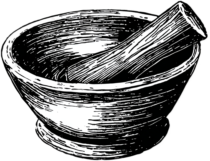
A pestle and mortar was how a cunning man or woman turned raw plants into medicine, alone, with one tool in each hand. The mortar held the plant steady. The pestle ground down into it. Neither did anything on its own, but together they took what went in whole, root, bark, or leaf, and brought it out crushed fine enough to steep in ale, boil into a decoction, or drink outright. The grinding itself was part of the cure, not just a step before it.
The herbs were not picked at random. Cunning folk followed herbalists like Nicholas Culpeper, who held that bay was the strongest of all: it “resisteth witchcraft very potently, as also all the evils old Satan can do to the body of man.” An affliction was rarely just an illness. Something had caused it, and the right herb, properly prepared, was believed to fight that cause directly, not only ease its symptoms.
Named remedies survive from across the country. Ursula Kemp, the Jack of Diamonds, steeped three leaves each of sage and St John’s wort in ale. William (Billy) Brewer, the Jack of Clubs, made a decoction of dried bay leaves and peppermint. One Exeter cunning-woman claimed her own medicine was made from eighteen ingredients at once, liquorice, alder and rum among them. Joseph Blagrave, a Reading physician, distilled marigold, rosemary and angelica together.
Everyone reached for something slightly different. Everyone ground it fine before they trusted it to work.
Nothing was ready until the grinding was done.
Sources
Owen Davies, Popular Magic: Cunning-Folk in English History (2003), pp.110–111. Joseph Blagrave, Astrological Practice of Physick (1671).