9♦ The Witch Bottle · Permanent End
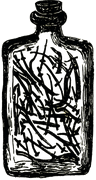
A witch bottle showed nothing from the outside. Sealed inside sat the sufferer’s own water, with pins, nails or needles dropped in after it and a little white salt. Corked shut and buried upside down at the threshold, it was made to work the affliction back onto whoever had sent it.
Joseph Blagrave, a Reading astrologer, printed the method as a plain recipe in 1671: “stop the urine of the Patient, close up in a bottle, and put into it three nails, pins, or needles, with a little white Salt, keeping the urine alwayes warm.” Leave it there long enough, he wrote, and it would endanger the witch’s life. They would be “grievously tormented making their water with great difficulty.”
Joseph Glanvil printed the fullest account, told to William Brearly of Christ’s College, Cambridge, who was lodging in Suffolk around 1640. His landlady had been ill a long time and could not sleep, haunted, she said, by a thing in the shape of a bird that fluttered close about her face. An old man who travelled up and down the country called in, told her husband it was only a dead spright, and set him a cure: bottle her water with pins and needles and nails, cork it fast, and stand it by the fire. The bottle began to joggle. He worked the fire shovel over it, on and off, until the cork bounced out and the urine and the pins and the nails flew up and went off with a report like a pistol. His wife was no better. It seems it was too nimble for you, said the old man on his next visit. Bury it in the earth instead, and that will do the feat. This time she recovered. Some while afterwards a woman walked over from a town miles away crying that they had killed her husband, a man they had never heard of. He had told her on his death-bed what he had done. He was a wizard, he had bewitched the wife of that house, and the thing in the ground had killed him.
In 2004 workmen in Greenwich turned up a sealed stoneware jar, still rattling. Opened later under laboratory conditions, it held urine that proved to be a smoker’s, along with sulfur, brass pins, clumps of hair, ten manicured fingernail clippings, and twelve iron nails, one driven straight through a small leather heart. It had been buried upside down, exactly as the books said, within a generation of Blagrave printing the recipe.
The habit outlasted the recipe. A small silvered flask, corked and sealed over with brown wax, was collected near Hove in 1915 from an old lady who explained it plainly enough. “They do say there be a witch in it”, she said, “and if you let him out there’ll be a peck o’ trouble”. It sits in Oxford now, still sealed.
Sources
Joseph Blagrave, Astrological Practice of Physick (1671), pp.154-155. Joseph Glanvil, Saducismus Triumphatus (1681), pp.205-207. Daniel Harms, Witch Bottles (2020). Samir S. Patel, “Opening a Witch Bottle,” Archaeology (2009). Pitt Rivers Museum, Oxford, accession 1926.6.1, via Ellen Ettlinger, “Documents of British Superstition in Oxford,” Folklore54:1 (1943), pp.231-232.