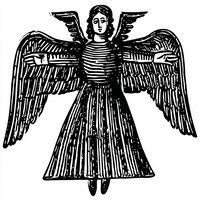
Joker The Angel · Providence
She is the face Providence wore when it arrived in person: vivid enough, documented enough, that she stands here as the embodiment of the divine power the cunning folk claimed. Not the only form that power took. But the one that gave it a presence, a figure, a face.
Joan Willimot, a Leicestershire cunning woman examined in 1618, described a spirit that stood upon the ground in the shape of a woman, sent by a mysterious master to do her good. James Murrell, the last great cunning man of Essex, summoned good spirits and angels to fight the bad ones. These were not theological abstractions. They were presences: encountered, described, worked with.
But the Angel was the visible face of something much larger. Providence expressed itself in ways that had nothing to do with angelic visitation: in the words Christ, Trinity, Holy Ghost spoken over the sick. Bridget Bostock healed six hundred people a day with fasting spittle and prayer. She never mentioned an angel. She did not need to. Providence was already moving.
This was the register the cunning folk’s communities recognised, the framework that kept most of them from the gallows. Not because it was a performance, but because it was real. Providence was genuinely what most of them believed they were working with, most of the time.
There are powers at work beyond your control. Trust them. Allow Providence to guide what comes.
Sources
Joan Willimot’s examination, in The Wonderful Discoverie of the Witchcrafts of Margaret and Phillip Flower (1619), full text at quod.lib.umich.edu. Arthur Morrison, “A Wizard of Yesterday,” The Strand Magazine, vol. 20, no. 118 (October 1900), pp.433-442. Jane Shaw, “Bostock, Bridget,” Oxford Dictionary of National Biography (2004). Owen Davies, Popular Magic: Cunning-Folk in English History (Hambledon Continuum, 2003). Emma Wilby, Cunning Folk and Familiar Spirits (Sussex Academic Press, 2005). Keith Thomas, Religion and the Decline of Magic (1971).