2♣ The Divining Rod · Finding
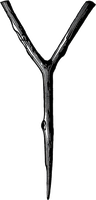
A divining rod was a forked branch, often of hazel, held loose, one arm in each hand. Walked slowly over ground believed to hide something, water, metal, or buried treasure, it was said to dip and pull downward on its own the moment it closed the gap between the person holding it and whatever they were looking for.
Richard Kitch believed treasure lay buried somewhere in Bridgwater, Somerset, and went looking for someone who could confirm it and find it. He first consulted a cunning-man named Old Leigh, who heard the report, agreed it was probably true, and sent him on to someone better suited to the actual finding: a cunning-woman named Anne Kingsbury. Kingsbury took up the search herself, working her rod over the ground of a house on St Mary’s Street until it answered her.
She said she had learned the method from William Lilly, the country’s most famous astrologer, and the claim held up. Decades earlier, in 1634, Lilly had worked hazel rods himself, in public, in the cloisters of Westminster Abbey, on a treasure-hunt organised with the King’s own clockmaker.
One man’s search, passed from hand to hand until it reached someone who could actually answer it, and a branch of hazel that closed the last gap on its own.
Sources
Owen Davies, Popular Magic: Cunning-Folk in English History (2003), pp.95–96. Keith Thomas, Religion and the Decline of Magic (1971), pp.235–236. Tabitha Stanmore, Love Spells and Lost Treasure: Service Magic in England from the Later Middle Ages to the Early Modern Era (2023), p.83. Edward B. Tylor, “Malay Divining Rods,” Man, Vol.2 (1902), pp.49–50, via Chris Wingfield, “Searching for the Main Spring: the Tylors, the Freemans and the Divining Rods,” Pitt Rivers Museum.