6♣ The Horseshoe · Expulsion
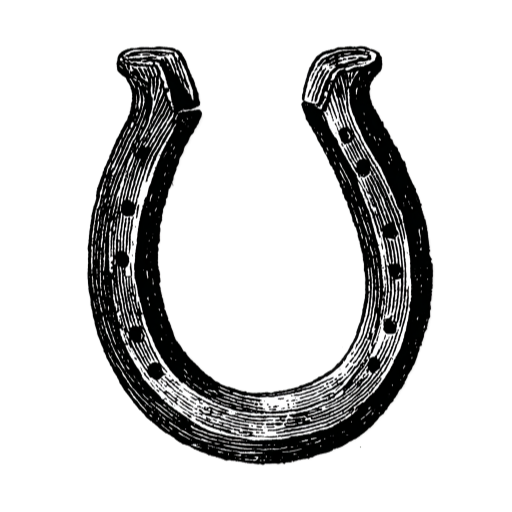
A horseshoe is iron, and iron has always been trusted to turn evil away. Joseph Blagrave, a Berkshire astrologer-physician who spent much of his career diagnosing witchcraft as the cause of illnesses doctors couldn’t otherwise explain, prescribed two of them for a sufferer past the point of simple warding. The first was heated red-hot and quenched in the patient’s own water, then nailed straight into the inside of the threshold with three nails, heel end pointing up. The second went into the same water once it was set over the fire with a trivet, horse-nails and white salt added, quenched in it again and again until the whole lot boiled away to nothing.
The horseshoe was never a lone remedy. It sat inside a whole catalogue Blagrave kept of rituals for exactly this purpose, rules for making the affliction travel back to whoever had sent it. Elsewhere in the same section he describes burning thatch or roof-tile soaked in the patient’s water and white salt, timed to the phases of the moon, the smoke and ash doing to the absent witch what the horseshoe did at the door. His own explanation for why any of it worked: the patient’s blood and water carried something of their vital spirit, and a witch’s magic could never be worked on a body without a trace of the witch’s own blood mixed into it. Burn that trace, and the witch burned too.
Blagrave’s own patients were not the only households doing this. Up in County Durham, farmers nailed a horseshoe over the stable door specifically to stop witches riding their horses ragged in the night, a defence one correspondent’s own family still kept up, paired with a sprig of broom hung over the rack for good measure. Yorkshire households did the same at their own front doors, plainer protection than Blagrave’s aggressive counter-strike, and held that any maiden lucky enough to find three horseshoes in a single year, thrown one by one over her left shoulder, secured herself, and later her own children, against ever being witch-held at all.
Nailed quietly over a stable door or boiled down to nothing in a sickroom, iron did the same job everywhere it hung. Get it out, and keep it out.
Sources
Joseph Blagrave, Astrological Practice of Physick (1671), leaf 141, Wellcome Library copy (archive.org/details/b30330610), quoted in Daniel Harms, Witch Bottles: History, Culture, Magic (2020), pp.35-36. William Henderson, Notes on the Folk-lore of the Northern Counties of England (1879), p.193. Richard Blakeborough, Wit, Character, Folklore and Customs of the North Riding of Yorkshire (1898), p.158.