5♥ The Soured Churn · Disruption
Cream that sat in the churn for hours, worked and worked, and never turned to butter, was not read as bad luck. In a farmhouse kitchen it was an attack, and the household usually had a fair idea of whose door needed knocking.
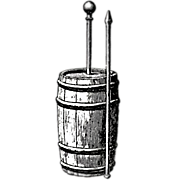
At Upleatham, on the North Riding moors, Hannah Rothwell’s butter had refused to come for three weeks running, and her neighbour Mary Parker’s cow had gone dry at the very same time. The two women walked over to see Jonathan Westcott, the district’s wise man, who named the cause straight away, a local woman called Peggy with a known grudge, and set Hannah a cure that left nothing to guesswork. The churn was scalded through three times over, first with salted water, then with water boiled with rowan berries, then with plain water again, and two rowan pegs driven into either end. On the last filling, turning the churn nine strokes between each line, she said over and over, “This tahm it’s thahn, t’ next tahm it’s mahn, an’ mahn foor ivver mair.” Only then did the butter come.
Other counties kept their own methods for the same complaint. A hot iron dropped straight into the churn did it in Lancashire, a crooked sixpence in Northumberland, and in Cleveland it took two pinches of salt, one thrown into the churn and one into the fire, nine times over. Whatever the county, the churn was one of the last places cunning folk had steady work. Thief-finding and love charms faded from most of their trade generations earlier, but a stubborn churn was still bringing a wise man or woman to a farmhouse door well into the twentieth century, right up until the churns themselves went out of use.
Nobody argued with a churn that had been put right. They just went back to churning.
Sources
Owen Davies, Popular Magic (2003), p.193–194. William Henderson, Notes on the Folk-Lore of the Northern Counties of England (1879), p.184.