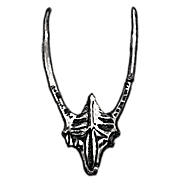
9♠ The Toad Bone · Dominion
The bone was small and forked, a crotch bone, one of the bones of the pelvic girdle. A man who had one was said to be able to do anything he liked with any horse he met. There is a detail in it that nobody invented: the bone is the same shape as the frog, the horny elastic pad in the underside of a horse’s hoof. The thing taken out of the toad matched the thing already inside the animal it was meant to command.
Albert Love, born 1886, of Wortwell in Norfolk, told George Ewart Evans how it was got, and gave the whole business its name. He called it the Water of the Moon. The toads came from around Fritton, near Yarmouth, the sort with a ring about the neck that the horsemen called walking toads. They were killed and set on a whitethorn bush, and left there a day and a night until they dried. Then they went into an ant hill and stayed a full month, until the moon came round to the full again, and the ants left nothing but the bones.
Then the hard part. You took the skeleton down to running water at midnight, and you watched it. One bone leaves the rest and floats uphill, against the current, and that is the one you want. What you must not do is look away. That, Love said, is where the power comes from, keeping your eyes on that particular bone. And while the bones are parting you hear the trees and every noise you can imagine, buildings coming down, a traction engine running over you. Across East Anglia the same warning ran through every account of it: do this carefully, because the Devil is looking over your shoulder.
Love got two lots through. The third time there was a crackling in the noises, as if somebody had fallen, and it made him take his eyes off the water. He was plain about what that cost him. There was no answer, he said. The bone had no power. He wouldn’t answer.
What a bone that did answer bought was total. It was taken home, baked, dried and broken to powder, kept in a tin, or mixed with oil in a bottle and carried in the pocket. A little on the finger, wiped across a horse’s tongue, his nostrils, his chin and his chest, and, in Love’s words, he is your servant and you can do what you like with him. Other horsemen kept the bone whole instead, cured, wrapped in linen and hidden somewhere about the body. Touched in the pit of the shoulder a horse would stand and not move; touched on the rump he was let go again. One of them said a horse dealt with that way couldn’t pull a duck off its nest even if he wanted to.
Nobody sold these. A month of waiting, and one night of not looking away.
Sources
George Ewart Evans, The Pattern Under the Plough (1966), pp.217-219. George Ewart Evans, The Horse in the Furrow(1960), ch.23. Norfolk Record Office, MS 21630/47 502X2 (c.1958).