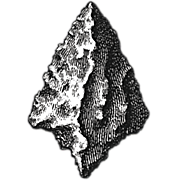
5♦ The Elf Shot · Affliction
A worked flint arrowhead does not belong in a freshly turned field, not one shaped and finished like this, and whoever struck it with the plough rarely thought it had landed there by chance. It was named on the spot: elf-shot, proof that an illness with no visible cause had a cause after all, small, sharp, and already spent.
At Bowness-on-Solway, on the Cumberland coast, the Bishop of Carlisle was shown a handful of them in 1712, kept in a house near the shore. His hosts would not part with a single one. Cattle that sickened without warning were elf-shot, they told him, and the arrowhead itself was the only proven cure, touched to the animal or steeped in water for it to drink.
The idea was old long before that visit. An English charm against a sudden violent pain names three unseen attackers who might be to blame, gods, elves, witches, and treats the wound without ever settling which one fired it. Six centuries later, a woman confessing to witchcraft in Scotland described the devil shaping elf-arrows with his own hands and passing them on for exactly this purpose. The words changed. The shape of the fear did not.
Sources
William Nicolson, “Bishop Nicolson’s Diaries,” Transactions of the Cumberland & Westmorland Antiquarian & Archaeological Society, New Series, vol. 4 (1904), p.58. Diary entry, 27 June 1712. Alaric Hall, Elves in Anglo-Saxon England (Boydell, 2007), pp.112-114.