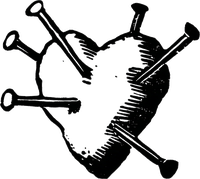
6♠ The Pierced Heart · Repaid in Kind
Sticking a heart full of pins and burning it was, by one Yorkshire witness’s own account, “perhaps the most widely adopted anti-witch charm” going, worked at midnight behind closed doors and windows, in absolute silence, with no one let in until it was done. Whatever had caused the trouble was expected to feel every pin.
In 1843, Charlotte Horn of Plymstock went looking for help for her mother Ann, who had been ill for some time, and found it in Agnes Hill of Plymouth. Hill’s cure came with a shopping list: fasting water, a live cock, and ash wood gathered from three separate parishes. Once everything was assembled, Ann cut the cock’s throat herself, over an earthen pan already holding the fasting water, letting the blood mix in. Hill cut the bird open and drew out its heart, then told Ann what to do with it, stick it with new pins, new needles, and blackthorn prickles, and hang it to roast before a fire built on the ash wood they’d carried in. When it was done, heart, pins and needles together went into the flames.
Witchcraft was never named outright, not once, but everyone involved understood exactly what they were fighting. Hill’s other remedies for the household ran just as far, whole pieces of Ann’s own furniture burned on her instructions. Word got out. The Plymouth court fined Hill for it, and by the time the case was over she had to flee the courtroom to escape a furious crowd waiting outside.
Devon was nowhere near alone in it. In Yorkshire, a farmer named William Dawson used the same remedy on a beast’s heart, nine new nails, nine new pins and nine new needles driven in, then burned on a rowan-wood fire at midnight to answer a run of cattle deaths. Somerset kept the practice going through the 1880s and 90s, sheep and pig hearts pierced and burned the same way at Ashbrittle, Staplegrove, a Wellington workhouse, and East Quantoxhead, four separate cases inside twenty years. One of the actual hearts survives: a sheep’s heart bristling with iron nails and steel pins, collected in South Devon by Edward Lovett and bought by Oxford’s Pitt Rivers Museum in 1911, still catalogued and kept.
Whatever had taken hold of that house in Plymstock, it was answered exactly as it came, measure for measure, right down to counting out the pins. The same reckoning was being made in farmhouses and workhouses the length of the country, in whatever heart came to hand.
Sources
Daniel Harms, Witch Bottles: History, Culture, Magic (2020), pp.27-28, citing a contemporary account, “Extraordinary Superstition at Plymouth.” Richard Blakeborough, Wit, Character, Folklore and Customs of the North Riding of Yorkshire(1898), pp.164-165. William Henderson, Notes on the Folk-lore of the Northern Counties of England (1879), p.219. F.T. Elworthy, The Evil Eye (1895), pp.53-56. Pitt Rivers Museum, Oxford, accession 1911.75.1.