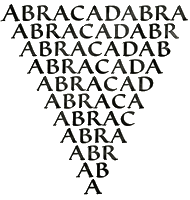
3♦ The Abracadabra Charm · Diminishing
Abracadabra was written eleven times, once for each letter, and every line after the first lost one more letter than the line before. By the last line, nothing was left. The word had disappeared off the page entirely, and whatever illness it had been written against was meant to disappear along with it. Worn folded around the neck against the first sign of a fever, it was one of the oldest preventions on record, taken up before the sickness could properly take hold.
A Roman physician named Quintus Serenus Sammonicus prescribed it centuries before England existed as a nation to write for: fold the word into a papyrus cone, wear it on a thread, and the fever would shrink as the word did. The instruction crossed a thousand years and a language without losing its shape. Reginald Scot recorded it plainly in his own time: written on paper with the proper figure and hung about the neck, it helped the ague. During the plague years of 1665, Londoners wore it and pinned it to their doors in triangle and pyramid form, hoping the same shrinking trick would work against something far worse than a fever.
By 1850, a Lincolnshire cunning man named William Martin of Bratoft was still selling it, though not entirely in earnest. He took ten shillings from a man named Tobias Davison, whose wife was unwell, and handed over a little parcel. Opened before the magistrates, it held the word, the twelve signs of the zodiac, and a rhyme so cheerfully irreverent that the court plainly wondered whether Martin believed a word of what he was selling.
Whether the seller believed it hardly mattered to the buyer. What mattered was catching the trouble early enough that eleven lines were still enough to finish it.
Sources
Owen Davies, Popular Magic: Cunning-Folk in English History (2003), pp.149-150, 154-155. Quintus Serenus Sammonicus, Liber Medicinalis (c. late 2nd/early 3rd century AD), ch.51. Daniel Defoe, A Journal of the Plague Year (1722).