The Cunning Folk
Stories Worth Being Retold
Richard Morris
Derbyshire and Shropshire, 1710–c.1793
♥ King of Hearts | Keyword: Mischief
Richard “Dick Spot” Morris was born in Bakewell, Derbyshire, the son of a soldier who died when he was six. His aunt Deborah Heathcote, a fortune-teller, raised him and taught him everything she knew. By the age of twelve he was already being consulted about lost cattle and stolen goods. He kept at it for nearly eighty years.
At the White Horse Inn at Frankwell, near Shrewsbury, on a market day, some men in the house urged Morris to make sport for them. An earthenware seller had set out his wares by the door. Morris said nothing. Within moments the man was smashing his own pans and pitchers with a stick, then ran off as if chasing something. Asked afterward what had come over him, he said, with tears in his eyes, that he had seen a great dog striding over his goods, pissing on them as it went, and that he had lost it in the pursuit, and he could not help lamenting that he had been under the Devil’s delusion.
The most celebrated story concerns a public house at Henllan in North Wales, where Dick stopped for refreshment on his way to Llanrwst and was charged fourpence for the ale and sixpence for the bread and cheese. He considered this outrageous. He paid it anyway. Before leaving he wrote a spell on a slip of paper, tucked it quietly under the leg of the table, and rode off into the dark, whistling.
That evening the serving girl began dancing around the kitchen, leaping and spinning, shouting “six and four are ten, count it o’er again.” The landlord came down to stop her and immediately began dancing himself. The landlady came to stop them both and immediately joined the dance. All three of them were spinning and stamping and shouting, unable to stop, when the noise woke the neighbours. One recognised the work of Dick Spot, saddled a horse, and rode after him. He found Morris some miles down the road, taking his time, still whistling. There was no need to hurry back, Morris said. Just burn the paper under the table. They burned it. The dancing stopped.
He once trapped a malicious spirit named Cynon beneath a rock in the Llanwddyn Valley, sealing it there until the water should work its way between the stone and the dry land. Many years later, the valley was flooded to supply Liverpool with water. The Welsh workmen refused to blast the rocks on the valley floor. When the stone was finally dynamited, a frog appeared on the rubble, sitting up and rubbing its eyes as if waking from a long sleep. The men stood at a distance and argued over whether it was truly a frog, or Cynon himself, freed at last. For nights afterward, people passing the spot said they heard the sound of chains dragging where the stone had stood.
He was tall and muscular, with a dark spot on the side of his face from whence his nickname took its life. He travelled the length of Derbyshire, Shropshire and North Wales on foot and later by carriage, reading stars, finding lost things, righting wrongs. The anonymous acquaintance who wrote his life, and who had observed him closely for nearly fifty years, declared that “a country conjuror is more useful in the place he resides in, than the fat vicar, who only sleeps and stirs about his tythes.” In later life his fee in all cases was a piece of gold. He owned the White Horse Inn itself, the very building where he had made his sport, and left it, with his other properties in Frankwell, in trust to the newly founded Manchester and Salford Lying-in Hospital.
Every story told about him is a story about a wrong turned into a joke, worth telling rather than nursing. The mole, presumably, went with him.
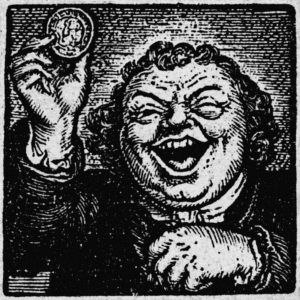
The image is a whimsical imagining based on the historical record, not an authentic portrait.