A♠ Inherited Craft · Received by Choice
The Gift received by Choice.
Some gifts exist only because someone has died and passed them on to a chosen one.
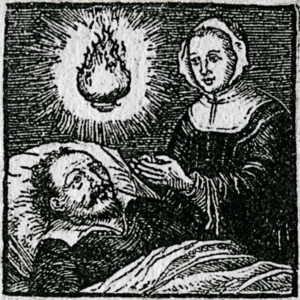
This was one of the most common ways cunning folk were believed to come into their power. Margaret Ley, a Liverpool witch tried in 1667, testified that when her mother died she had nothing else to leave her two daughters but her two familiar spirits, one named to Margaret, the other to her sister. Cunning practice passed the same way more than once. Richard Morris was trained in his youth by his aunt Deborah Heathcote, and took up her practice after her death. Hannah Spence succeeded her own mother, the celebrated Yorkshire wise-woman Hannah Green, when Green died in 1810. One of Timothy Crowther’s sons took over his father’s trade.
Among charmers, a closely related tradition, the belief ran further still: a charm could be withheld entirely until the charmer’s final hour, and was thought to fail completely unless it passed to someone of the opposite sex. Not automatic. Not given to whoever happened to be standing nearest. Chosen, and only at the very end.
Its name in this deck is Inherited Craft. It is not loss. It is the one moment a gift can change hands complete, entire, with nothing of it left behind.
That is what Spades is. Something ends, so that something else can finally begin.
Sources
Emma Wilby, Cunning Folk and Familiar Spirits (Sussex Academic Press, 2005), pp.60-61. Owen Davies, Popular Magic (2003), pp.72-73, 82-83. Owen Davies, “Cunning-Folk in England and Wales during the Eighteenth and Nineteenth Centuries,” Rural History 8:1 (1997), p.97. Ronald Hutton, The Triumph of the Moon (Oxford University Press, 1999), ch.6.