2♠ The Barrow · Spirit Counsel
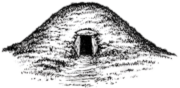
A barrow was an ancient burial mound, and cunning folk believed it was one of the surest places on earth to reach a spirit. Not by chance, on purpose, at a set hour, with the right preparation made first.
In 1566, a Dorset cunning man named John Walsh described exactly how it was done. He went up onto the hills, to the great heaps of earth raised there long before his own time, and waited for noon or midnight, the only hours the spirits would answer. He carried a book with circles drawn in it, and at the mound he set two candles of virgin wax crosswise on the ground. By that light, inside that circle, he raised the spirit and asked it what he needed to know.
Another cunning man, from the north of England a generation or so later, kept the same kind of visit going for years. He went to a particular hill whenever he needed help, knocked on it three times, and said, “I am coming, I am coming.” The hill opened onto a great hall, where a queen received him and had her attendants give him a box of white powder, a few grains enough to heal the sick. When the powder ran low, he went back, knocked three times again, and was let in the same way.
Nothing about either visit was casual. The ground had to be the right ground, the hour or the words had to be exactly right, and the mound gave up nothing until they were. Get any part of it wrong, and nothing happened at all.
A barrow answered only those willing to meet it on its own terms, and not before.
Sources
Emma Wilby, Cunning Folk and Familiar Spirits: Shamanistic Visionary Traditions in Early Modern British Witchcraft and Magic (2005), p.79 and footnote 54 (Webster, 1677, p.301). Owen Davies, Popular Magic: Cunning-Folk in English History (2003), pp.93–96. J.C. Atkinson, Forty Years in a Moorland Parish: Reminiscences and Researches in Danby in Cleveland (1891), pp.137–141.