3♠ The SATOR Square · Warding
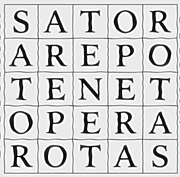
SATOR, AREPO, TENET, OPERA, ROTAS. Five words, arranged in a grid, and however you read them, forward, backward, top to bottom, bottom to top, they come out exactly the same. Cunning folk scratched the square into walls, wrote it on paper worn folded against the skin, and carved it into wood, always before trouble arrived rather than after, because a shape with no weak side and no way in has nothing for harm to grab hold of.
A Somerset charm from the end of the nineteenth century opened with the square as its very first line, before running on into a string of divine names for good measure. Cornish cunning-folk wrote the same square on parchment, folded small, for the same protective purpose. The square itself is far older than either of them: it turns up scratched on Roman wall-plaster at Cirencester and on a broken pot in Manchester, and in 1614 someone carved it into an oak board and fixed it to the wall of the parish church at Great Gidding, in Cambridgeshire, where it stayed. One example survives today in a museum’s own collection, incised on slate, kept for exactly the reason it was made: to overcome danger and difficulty before either had the chance to properly arrive.
Reginald Scot’s Discoverie of Witchcraft, printed in 1584, did more than any other book to carry charms like this one out of private hands and into wider English use. Whatever Scot himself thought he was exposing, the effect was the opposite: readers came away with the very formulae he meant to debunk.
Nothing in the square points a way through it. That was always the whole idea.
Sources
Owen Davies, Popular Magic (2003), pp.125, 153-154. Museum of Witchcraft and Magic, Boscastle, object 1583. Reginald Scot, The Discoverie of Witchcraft (1584).