4♥ The Nativity Chart · Destiny
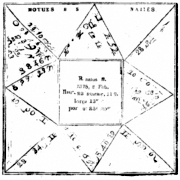
A nativity chart mapped the sky at the exact moment of a child’s birth, the planets fixed in position for that one instant and never again. Cast properly, it did more than predict a life. Read afterward, it could explain what had already gone wrong with one.
In 1795, a Chichester mathematician and astrologer named James Hallett advertised himself as “the original curer of all diseases” and offered nativities cast specifically “for the cure of witchcraft.” His handbill, printed with an engraving of himself seated among the tools of his trade, promised that the same chart used to foretell a life could be read backwards too, to find the moment misfortune had entered it.
Simon Forman, this deck’s own King of Clubs, cast nativities among the thousands of charts he drew up each year. Most were cast for the instant a client’s question reached him, but when the event in question was a birth rather than a question, the method held: a chart fixed to one unrepeatable moment, read for everything it could tell. The same skill served ordinary business too. Calculating a nativity could settle whether a venture would prosper, when a marriage should take place, or where stolen goods had gone, a trade John Steward and John Vaux were both still running a century apart.
By 1600, the skill had become the very measure of learning itself. “Nowadays among the common people,” it was said that year, “he is not adjudged any scholar at all, unless he can tell men’s horoscopes, cast out devils, or hath some skill in soothsaying.”
Once cast, the chart did not change. What it showed had already happened. The only choice left was what to do with the knowledge.
Sources
Owen Davies, Popular Magic: Cunning-Folk in English History (2003), p.115. Tabitha Stanmore, Love Spells and Lost Treasure (2023), pp.59-60. Keith Thomas, Religion and the Decline of Magic (1971), p.227. Lauren Kassell, Michael Hawkins, Robert Ralley and John Young, “Early Modern Astrology,” A Critical Introduction to the Casebooks of Simon Forman and Richard Napier, 1596–1634 (Casebooks Project, University of Cambridge).