5♠ The Wax Figure · Manipulation
Eleanor Cobham was Duchess of Gloucester, married to Humphrey, the king’s own uncle and, since the young Henry VI had no children of his own, next in line to the throne after him. By 1440 Eleanor was forty and more than a decade into that marriage without a child of her own, her safest years for bearing one now behind her. She turned to Margery Jourdemayne, this deck’s own Queen of Hearts, who had already been supplying her with love charms since before the wedding, and asked for something stronger. Questioned later by a panel of bishops, Eleanor admitted what it was for: to “have borne a child by hir lord, the duke of Gloucestre.”
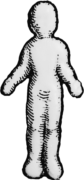
Around the same time, two men in Eleanor’s own household, her physician Thomas Southwell and an Oxford scholar named Roger Bolingbroke, had cast a horoscope for King Henry VI and read in it that he would fall dangerously ill within the year. That was not an innocent thing to have predicted. Because Humphrey stood to inherit the throne if the king died, anyone close to Humphrey’s wife foretelling the king’s death looked less like astrology and more like a wish, or worse, a plan. Southwell and Bolingbroke were arrested. And when the investigation turned up Margery’s wax figure, made for Eleanor, it stopped being read as a fertility charm and started being read as part of the same plot: an image shaped, so the accusation went, to waste away as the king’s own life waned with it.
The three of them paid for it unevenly. Southwell died in the Tower before his sentence could be carried out, probably by his own hand. Bolingbroke was hanged, drawn and quartered, his head set on London Bridge and his limbs sent to four English cities. Margery, the only one of the household with no rank to protect her, was burned alive at Smithfield. Eleanor herself, protected by her title, was spared execution and sentenced instead to public penance and life imprisonment.
Historians still argue about what that image was actually for. Some read it exactly as Eleanor herself did: a fertility charm, wax shaped and warmed to help a marriage bear fruit. At least one reads the very same object the other way entirely, as something meant to harm a king, not help a duchess conceive. Nearly six hundred years on, nobody who never saw the thing has managed to agree on what it meant.
It was not the only wax figure whose purpose got argued over. Decades after Margery’s death, a small wax doll turned up in England with the name “Elizabeth” scratched into it, and given who sat on the throne by then, some feared it was aimed at the queen’s own life. Not long after, a play called Fedele and Fortunio, performed for Elizabeth herself, acted out how such a doll was really supposed to work: pricked or held to a flame to make somebody fall in love, not to kill anyone. Nobody could prove which one that doll had actually been for either. The method itself was already old even in Margery’s day. Back in 1324, two men shaped wax images of King Edward II and spent months sticking them with pins in a house outside Coventry, a plot to kill a king by wax that predates Margery’s own case by more than a hundred years.
What the figure was made to do and what it was found to mean were never the same question.
Sources
G.L. Harriss, “Cobham, Eleanor,” Oxford Dictionary of National Biography (2004). Jessica Freeman, “Sorcery at Court and Manor: Margery Jourdemayne, the Witch of Eye Next Westminster,” Journal of Medieval History 30 (2004). R.A. Griffiths, “The Trial of Eleanor Cobham: An Episode in the Fall of Duke Humphrey of Gloucester,” Bulletin of the John Rylands Library 51 (1969). Gemma Hollman, Royal Witches: Witchcraft and the Nobility in Fifteenth-Century England(2019). Francis Young, Magic as a Political Crime in Medieval and Early Modern England (2018). Tabitha Stanmore, Love Spells and Lost Treasure (2023), pp.64-65, 119.