7♥ The Psalm · Intercession
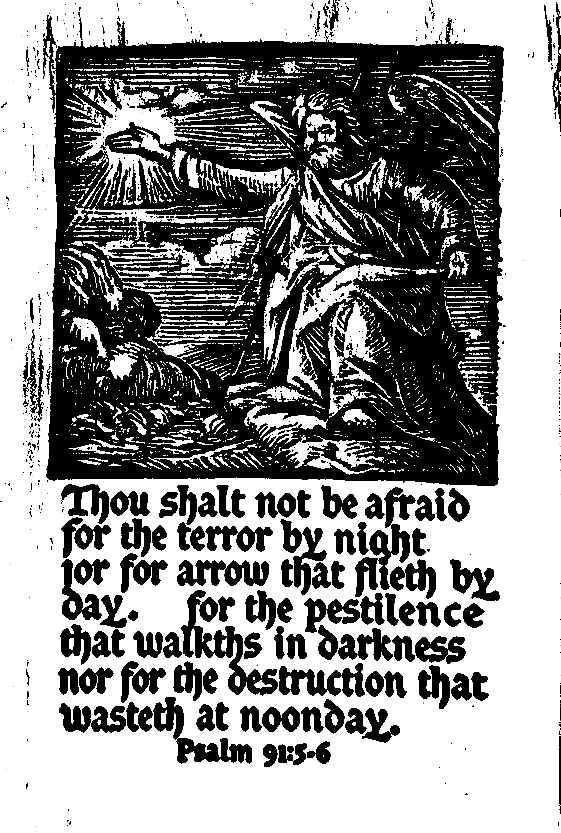
Cunning folk never pretended to work outside the church’s own authority. Many borrowed it outright, reading psalms and prayers aloud as part of a cure, or setting their clients to do the same. One Yorkshire cunning-man prescribed a bewitched patient a fixed course of scripture: Matthew’s tenth chapter and Psalm 70 read together, then Deuteronomy’s twenty-eighth chapter read over seven times, always at eleven at night. Clients rarely saw this as borrowed authority at all. One of a clergyman’s own rustic witnesses insisted a local cunning-woman “did more good in one year than all these scripture men will do so long as they live,” and a Cornish vicar complained that even his most churchgoing parishioners believed only Scripture words, or words just as good, ever went into a real charm.
Reading scripture aloud was one way to use it. Writing it down and hiding it was another, and one particular Latin charm had an unusually long life. Reginald Scot printed it in 1584: a line from St Luke’s gospel stitched to a line from Psalm 68, “Let every spirit praise the Lord: they have Moses and the prophets: Let God arise and his enemies be scattered.” His own instruction was to write it on virgin parchment and hang a copy in each of the four corners of the house.
The charm outlived him by centuries. A popular chapbook, sold as a “night-spell to catch thieves” and falsely credited to the astrologer William Lilly, carried the same Latin into print shops in Newcastle, Warrington, and Coventry, running through at least eleven editions in Newcastle alone. A Nottinghamshire cunning-man was still handing a version of it to a client in 1866, sold as protection against witchcraft. Both the chapbook and Scot’s own text agreed on where it belonged: the four corners of the house, garden, or orchard.
One household went further. Around 1900, a farmer near Pendle, in Lancashire, kept his own copy, the Latin worn down to near nonsense by whoever had copied it out in an unpractised hand. He had moved it from the corners to the doorway itself, tucked into the gap above the frame, doing its work quietly on everyone who passed beneath it. He kept a second copy for the fields, with one line added: a plain command that the cattle there should prosper. When an old cow-house in neighbouring Yorkshire was pulled down around the same time, more copies of the same charm, garbled further still, turned up tucked into holes above the stalls, standing guard over animals rather than people.
The doorway itself drew more than one kind of charm. Near Burnley, another household kept a written protection over its own door with no scripture in it at all, just the planets and the astrological aspects named one after another, “Sun, Moon, Mars, Mercury, Jupiter, Venus, Saturn, Trine, Sextile, Dragon’s Head, Dragon’s Tail,” charging them to guard the house from evil spirits and keep the family in health and wealth. Whatever filled the paper, the gap above the door was where people trusted it to work.
Whoever had written it down never had to stay and watch it work. Three hundred years and half the country later, the scripture was still doing that on its own.
Sources
Reginald Scot, The Discoverie of Witchcraft (1584, ed. Brinsley Nicholson, 1886), p.295. Owen Davies, Popular Magic: Cunning-Folk in English History (2003), p.62, pp.150-152. John Harland and Thomas Turner Wilkinson, Lancashire Folk-Lore (1867), pp.80-81.