7♦ The Blessed Ring · Many Hands
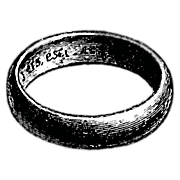
Once, only a king could do this. Every Good Friday from the reign of Edward III to that of Mary Tudor, the monarch blessed a plateful of gold and silver rings at the altar of the Chapel Royal, rubbing them between royal fingers said to carry the same healing touch that cured the King’s Evil. Given freely, without money or petition, they were believed to cure epilepsy, cramp, and palsy in whoever wore one after. When Elizabeth’s reign ended the custom, the cure did not end with it. People simply began making the rings themselves.
A farmer travelled from village to village near Ilsington, in Devon, collecting sixpences, one from each of seven unmarried women in seven separate parishes. His son had suffered for years from “the falling sickness,” and medicine had done nothing for him. Someone had told him the coins had to pass through seven hands before a silversmith could melt them down into a ring, and the boy would have to wear nothing else. He didn’t know how many miles he’d walked collecting them by the time he reached the last house on his list, only that he meant to finish.
The method varied by county, but the principle held everywhere it was practised. In Yorkshire, the coin had to come straight from the church collection: the Vicar of Danby, near Whitby, was once asked by one of his own most respectable parishioners for a halfcrown taken from the plate, thirty pence tendered in exchange, so it could be reforged as a ring for an epileptic relative. A Lincolnshire account-book from 1754 records a poor woman at Barton paying towards “a silver ring” for her fits. Rings made the same way, from money blessed by passing through the church, were still being worn against epilepsy in the Forest of Dean when this custom was first written down. Hereford had its own version by the mid-seventeenth century, Berkshire by the eighteenth. In Cheshire, the shilling came from twelve pennies begged from twelve people of the opposite sex to the sufferer. In Suffolk, no coin was melted at all, twelve scraps of broken silver did the same work.
None of it worked by the metal alone. What did the work, in every version of the story, was the money’s journey first, through a church collection, through a chain of strangers’ hands, through whatever passage made it belong to something larger than the person who carried it afterward. A commoner’s ring, made by begging round a parish, was doing in miniature exactly what a king had once done at the altar of his own chapel.
Some cures don’t come from your own hand. They come from what the coin passed through on its way to you.
Sources
William Henderson, Notes on the Folk-Lore of the Northern Counties of England and the Borders (1879), pp.146-147. Jacqueline Simpson and Steve Roud, A Dictionary of English Folklore (Oxford University Press, 2003), “Cramp rings” entry.