7♠ The Three Biters · Deliverance
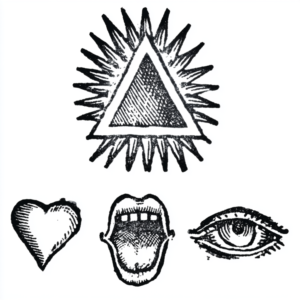
“Three biters have bit him, heart, tongue and eye; three better shall help him presently, God the Father, God the Son, and God the Holy Spirit.“
That is the whole of it. Twenty-six words said over a man who believed himself bewitched, with a little oil smoothed onto his skin, and nothing else required.
The charm names its enemy with a precision worth pausing over. The heart is the ill-will someone holds and never says. The tongue is what they do say, the bitter word let loose behind your back. The eye is the look itself, the glance that withers what it lands on. Between them they cover the whole anatomy of malice, everything a neighbour can do to you without ever laying a hand on you. And the charm’s answer is not to argue with any of it. It counts the enemy, three, then counts what is coming against them, three, and lets the reader work out which three weigh more.
The man who said them was a London practitioner named Robert Booker, and the year was 1622, but he did not invent a word of it. This was a standard formula. Copies survive in manuscript, tucked into commonplace books and quarter sessions papers, one of them written out by a Lancashire charmer questioned in 1634. Other cunning folk kept to the written version of the same idea. A Nottingham sorcerer called Groves sold his clients copies of St John’s Gospel as a preservative against witchcraft. A century after him, the cunning-man Richard Walton was writing out much the same thing on scraps of parchment, the opening of St John’s Gospel and many of the divine names belonging to God and his Holy Angels, ending with a request that the angel of God preserve the bearer from witchcraft or evil tongues. Walton’s charm was read out in court and misread there, taken for a spell to keep a horse-thief from arrest. He was bitter about it afterwards. If the gentlemen of the jury had read the thing properly, he said, they would have seen it only ever concerned witchcraft.
There was something quietly out of step about all of it. The Church of England had no place for this. When these charms turn up in a cunning person’s hands their Catholic ancestry is written all over them, in the Latin, in the Aves and Paternosters counted out in fives and fifteens, in the old assumption that holy words are things you can hold and carry and set to work. This was power from a religion the country had officially left behind, still doing business in back rooms two hundred years after the fact, because people had never stopped believing it was the strongest thing available.
What runs through every version is the same refusal to fight on the enemy’s terms. Somebody wished you harm, and the answer was never to wish harm back, never to hunt for who it was, never to send anything into the dark after them. The answer was to stand behind something that had never lost, and let it do the standing.
Sources
Owen Davies, “Cunning-Folk in the Medical Market-Place during the Nineteenth Century,” Medical History 43 (1999), p.71. J. R. Chanter, “North Devon Customs and Superstitions,” Transactions of the Devonshire Association (1867), pp.38-42.