8♠ The Hag Stone · Reprieve
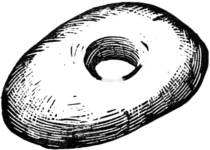
Nobody made it. A pebble with a hole worn clean through by water, picked up off a beach or turned over in a field. They were called self-bored stones, and that was the point of them: the hole had to have made itself. In the north-east they were adder stones, in the North Riding a lemmel-steean, elsewhere a witch stone or simply a holey stone.
What they were for was the night.
To be hag-ridden was to surface in the small hours unable to move, with a weight on your chest and the certainty that something was in the room with you. The earliest English mention of the stone comes in a charm against nightmares from the fifteenth century. Small ones went in a pocket or hung over the bed, and one from Exmouth was kept hanging on a bedstead for exactly that.
But the hag did not only ride people, and a horse could not tell you what had happened to it. You knew because you came out at first light and found the animal standing in its stall wet through and trembling, having been somewhere all night without ever leaving the building.
John Aubrey wrote it down in 1686. “In the West of England (& I beleeve, almost everywhere in this nation),” he said, “the Carters, & Groomes, & Hostlers doe hang a flint (that has a hole in it) over Horses that are hagge-ridden for a Preservative against it.” A Devon charm was more exact about it: eight holed stones on a string tied with five knots, hung up in the stable, and the pixies would not be able to night-ride your horses.
Two hundred years after Aubrey, a carter called Kimber, working for General Pitt Rivers at Rushmore in Wiltshire, nailed a holed stone to his own cottage door to keep the witches off. The stone is in a museum in Oxford now, and his name is still on it.
They spread well past the stable. At Whitby people tied small ones to their front-door keys to keep the household prosperous. At Weymouth the boatmen fastened them to their bows. In Brighton the women of the fishing families wore necklaces of little holed fossil sponges, sold along the front for luck.
Whatever the water had done to those stones, people trusted it more than anything they could have made themselves.
Sources
Jacqueline Simpson and Steve Roud, A Dictionary of English Folklore (Oxford University Press, 2003), “holed stones” entry, quoting John Aubrey (1686) and Notes & Queries (July and August 1894). William Henderson, Notes on the Folk-Lore of the Northern Counties of England and the Borders (1879), p.166. Richard Blakeborough, Wit, Character, Folklore and Customs of the North Riding of Yorkshire (1898), p.158 and glossary. Pitt Rivers Museum, Oxford, catalogue no. 540/12191, via Ellen Ettlinger, “Documents of British Superstition in Oxford,” Folklore 54:1 (1943). Museum of Witchcraft and Magic, Boscastle.