9♣ The Sieve & Shears · The Guilty Party
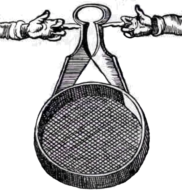
A pair of shears was driven into the rim of a sieve, the whole thing hung from the points, and two people held it up on their fingertips. Then the names were spoken. John Aubrey set the words down as a call and an answer, one side saying “By St Peter and St Paul such a one hath stoln it,” the other answering “By St Peter and St Paul he hath not stoln it,” name after name, until the sieve was said to turn in their hands and settle the matter.
It needed no skill and nothing you did not already own, which is why it turns up for so long and so far apart. In 1554 William Hasylwoode, a cleric of Hornsey, stood before the Commissary’s Court of London and explained himself. He had lost his purse with fourteen groats in it, and he remembered that when he was a child he had heard his mother say that when any man had lost anything, then they would use a sieve and a pair of shears to bring to knowledge who had the thing lost. So he hanged the sieve by the point of the shears and said the words, “By Peter and Paule, he hath yt,” naming the man he suspected. He had done it once in his life, he told them, and mentioned it to one acquaintance. He was given penance. Forty-four years later John Casson answered for the same thing before the Archdeacon of Nottingham after a wether went missing, saying he had tried it with his sister, once, without any ill intent. Casson had called on the Father, the Son and the Holy Ghost rather than the two saints. The words were interchangeable. What mattered was that something was invoked and the sieve moved.
In London it made reputations. William Wycherley, questioned in 1549, listed the men he knew who worked it, Thomas Shakilton of Aldersgate Street among them, who had “doon therwith many praty feates, and many trouthes tryed out.” Eighty-four years later a Worcester woman named Ann Bellett was up before the quarter sessions for “the evil art that she useth with the juggling trick of the sire and sheves,” calling on Peter and Paul, the court said, in profane manner. The formula had barely shifted in three generations. Neither had the charge.
The fullest account of it working comes from Castleton in Lancashire in 1641, where three women were examined. Alis Scholfield had learned to set the sieve and shears off Jane Brearley. It was held up on Jane’s finger and Mary Fielden’s, and Alis spoke what Jane could only describe as many strange words. Mary remembered them better: that if Samuel Greame did steal the hen, then St Peter said so, St Paul said no. The same two saints as Aubrey’s, worn down into a rhyme. The sieve turned about at the name, Mary said. It had already been asked who took James Newbold’s sheep, and while they had it in hand they asked it whether Mary and Jane were themselves with child. The hen, the record adds, had left the house in John Chadwicke’s breeches.
By the nineteenth century the whole practice had simply stopped. Nobody wrote down why. It was tried less, and then it wasn’t tried at all.
Whoever held the shears never had to say the guilty name themselves. The sieve said it for them, and everyone in the room understood exactly what had just turned.
Sources
John Aubrey, Remaines of Gentilisme and Judaisme (written c.1686, ed. James Britten, 1881), p.25. William Hale, A Series of Precedents and Proceedings in Criminal Causes (1847), p.139. Owen Davies, Popular Magic (2003), pp.99-101. Keith Thomas, Religion and the Decline of Magic (1971). Tabitha Stanmore, Love Spells and Lost Treasure (2023), pp.53-55, 79-80. John Gough Nichols, ed., Narratives of the Days of the Reformation (1859), pp.334-335. Deborah Lea, Witchcraft, Possession and Confessional Tension in Early Modern Lancashire (2011), pp.60-61.