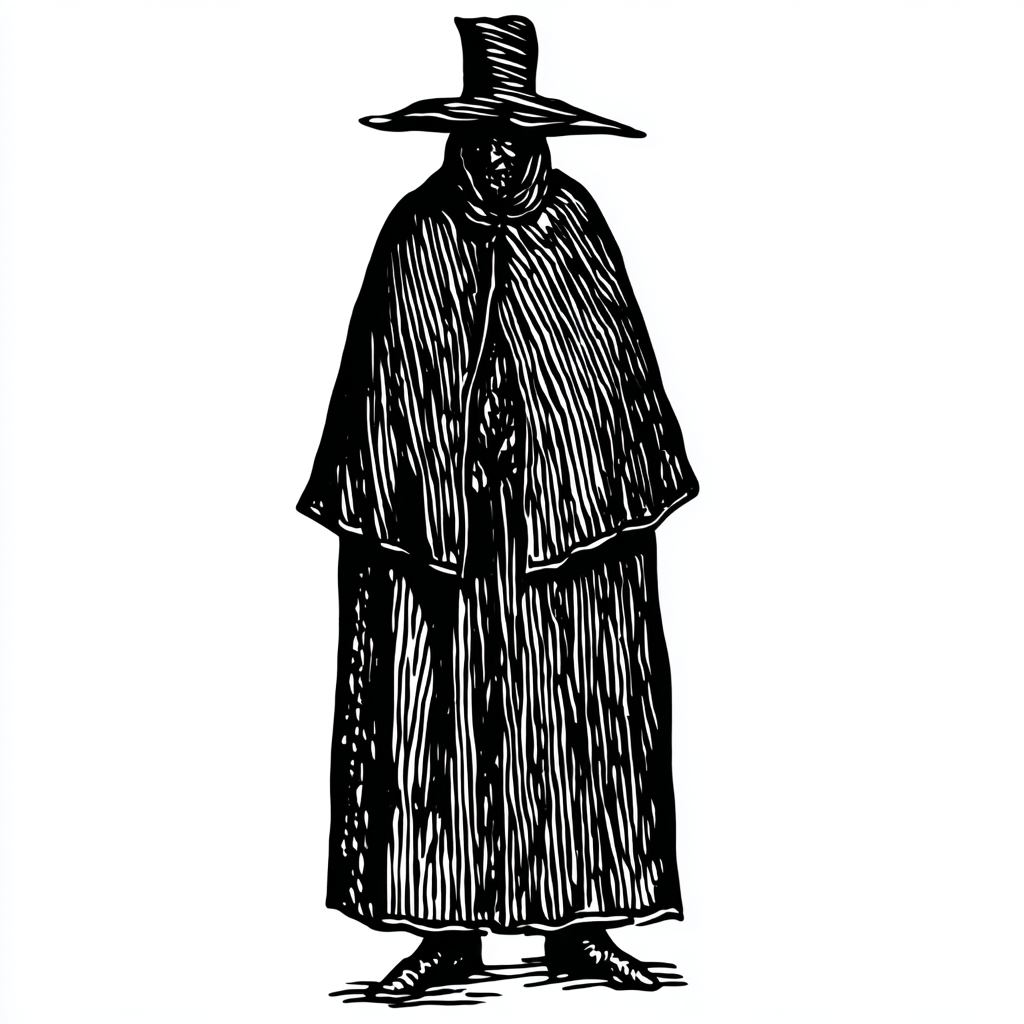
Joker The Man in Black · Opposition
He is the face Opposition wore when it became visible enough to write down.
In Huntingdonshire in 1646, a spirit appeared to Jane Wallis as she made her bed and gave his own name as Blackman, standing before her “in the shape of a man in blacke cloaths.” In Somerset in 1665, Elizabeth Style and Alice Duke called him only the man in black, the same phrase the record repeats every time he appears. He brought the wax image to be baptised in a child’s name, stood godfather to it, and supplied the wine, the cakes and the roast meat while the company danced. A year before that, in the same county, a different group met a lighter version of him: “a little Man in black Clothes” who tipped his hat and asked, low voiced, “How do ye?” before he asked for anything at all. In Lancashire in 1634, Margaret Johnson’s own demon came to her better dressed than most men she knew, “apparelled in a suit of black tied with silk points.”
These are witch trial records, not the records of cunning folk practice, and that distinction should not be blurred. But the world was small, and cunning folk and their clients moved through the same landscape these trials describe. Very few cunning folk were ever prosecuted under the Witchcraft Acts; ordinary people drew a clear line between a witch’s familiar and a cunning person’s craft. The Man in Black stood on the far side of that line, the adversary the whole trade existed to counter, not a figure any of them would have claimed as their own.
He comes closest to their actual practice in the case against Anne Bodenham, a Salisbury woman who found stolen goods in a green glass and charged twelve pence for it, and who is named in the record itself as “the cunning woman.” When her accuser Anne Styles fell into her fits, a boy in the room, too frightened to leave, saw “a spirit in the likeness of a great black man, with no head,” come to claim her soul. Awaiting her own trial, Bodenham gave her account of such spirits to a friend who visited her, in her own words: there was no hurt in them, she said, only that “they would doe a man all good offices, attending upon him and guarding him from evil all his life long.” Two witnesses, describing the same kind of figure from opposite ends of the same case, and neither one uncertain about what they had seen.
Sources
John Davenport, The Witches of Huntingdon, Their Examinations and Confessions (London: W. Wilson for Richard Clutterbuck, 1646); Joseph Glanvill, Saducismus Triumphatus: or, Full and Plain Evidence Concerning Witches and Apparitions (London, 1681); Edmond Bower, Doctor Lamb Revived, or, Witchcraft Condemn’d in Anne Bodenham(London: T. W. for Richard Best and John Place, 1653); Doctor Lambs Darling: or, Strange and Terrible News from Salisbury (London, 1653); Henry More, An Antidote Against Atheism, 2nd edn (London, 1655); Emma Wilby, Cunning Folk and Familiar Spirits: Shamanistic Visionary Traditions in Early Modern British Witchcraft and Magic (Brighton: Sussex Academic Press, 2005); James Sharpe, “In Search of the English Sabbat: Popular Conceptions of Witches’ Meetings in Early Modern England,” Journal of Early Modern Studies 2 (2013): 161–183; and Deborah Lea, “Witchcraft, Possession and Confessional Tension in Early Modern Lancashire” (PhD thesis, University of Liverpool, 2011).