The Cunning Folk
Stories Worth Being Retold
Anne Jefferies
St Teath, Cornwall, 1626–1698
♥ Jack of Hearts | Keyword: Wonder
Anne Jefferies was born in December 1626 in the parish of St Teath in north Cornwall, the daughter of a poor labourer. She never learned to read.
At nineteen she went to work as a servant for the Pitt family. One afternoon, knitting in the garden, she looked up to find six small people in green coming over the hedge. The fright dropped her into a fit, and she was carried inside and put to bed. She did not recover quickly, drifting in and out of fits for months, insisting each time that the fairies had “just gone out of the window.”
By harvest time, still weak from the fits, she healed someone for the first time. The mistress of the house had fallen badly in a lane, alone, and Anne knew where it had happened, and how, before anyone told her. She took the injured leg onto her lap, stroked it, and the pain eased at once. She refused to let anyone send for a surgeon. The leg was whole within days. From that same harvest time until Christmas she ate nothing anyone in the house could see or provide. On Christmas Day she came to the table and ate roast beef with the rest of them, because it was Christmas.
Word spread. People came from across Cornwall, then from London, healed with salves she said the fairies had given her. She could curse, as well, when it suited her. She never took a penny, and yet never wanted for money, and no one ever discovered where it came from.
A neighbour once came looking for her and searched her chamber by hand in the dark, calling her name, and found no one there. She walked out a moment later and said she had been at her table the whole time, eating her dinner, watching him fail to find her. A later account flattens this into a claim that she could turn invisible at will. What actually happened is smaller and stranger: a man patted the air of an empty room while she sat and watched him do it.
The ministers came eventually, to tell her the fairies were devils. She went to her chamber alone that night and came back with the family Bible already open to a single verse she could not have found herself, not being able to read: believe not every spirit, but try the spirits, whether they are of God. Around the same time it was said her fairies had told her the King would have his throne again, an unsafe thing to be overheard saying in the most royalist county in England. A local justice, John Tregeagle, sent for her. What exactly she was charged with was never made clear, sedition and witchcraft both circled her at once, and the record does not settle which brought Tregeagle to her door.
The fairies told her the constable was coming before he arrived. When she asked if she should hide, they said no, to go with him. She was taken to Bodmin gaol and kept without food. She did not starve. She was later held in Tregeagle’s own house too, again without food, and again came to no harm.
She was eventually released, kept healing, and married, though even now the name will not quite settle, Warden in the earliest record, Warren in most that copy it, Werrin in the one drawn from the parish register itself. Nobody wrote down when the fairies stopped coming, or why. Pitt, asked, said only that he did not know.
Fifty years on, Moses Pitt, grown and a London publisher, sent someone to find her and ask her to tell it all again. Anne was seventy by then. She denied every part of it and told him plainly she would not have her name spread through books and ballads for five hundred pounds. That, she said, was final.
She had told her story once, to the people who were there, and considered that sufficient.
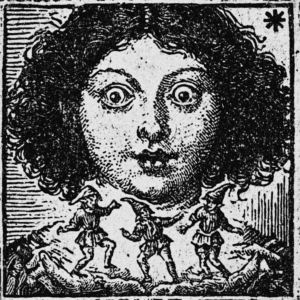
The image is a whimsical imagining based on the historical record, not an authentic portrait.
Sources
Moses Pitt, An Account of one Ann Jefferies, now living in the County of Cornwall (1696), full text at quod.lib.umich.edu. Pitt’s letter to William Turner, reprinted in William Turner, A Compleat History of the Most Remarkable Providences (1697). Joseph Morgan, reprint of Pitt’s account, in Phœnix Britannicus (1732). C.S. Gilbert, An Historical Survey of the County of Cornwall, Vol. I (1817). Robert Hunt, Popular Romances of the West of England (1865), including the 1903 edition’s appendix reprint of Pitt’s letter. G.C. Boase and W.P. Courtney, Bibliotheca Cornubiensis (1874). Henry Richard Tedder, “Pitt, Moses,” Dictionary of National Biography (1885–1900). Sabine Baring-Gould, Cornish Characters and Strange Events (1909). Barbara C. Spooner, John Tregagle of Trevorder: Man and Ghost (1935). Emma Wilby, Cunning Folk and Familiar Spirits (2005). Peter Marshall, “Ann Jefferies and the Fairies: Folk Belief and the War on Scepticism in Later Stuart England,” in Angela McShane and Garthine Walker (eds.), The Extraordinary and the Everyday in Early Modern England (Palgrave Macmillan, 2010). Calendar of Clarendon State Papers, Vol. 1, ed. Ogle and Bliss (1872), letters dated 1647. Katherine Briggs, An Encyclopaedia of Fairies, entry “Jefferies, Anne” (1976). Anders Ingram, “History of St Teath woman who claimed to have had encounters with fairies comes to light,” thepost.uk.com (2019).
Foundational sources are available on The Sources page.