
The Cunning Folk
Stories Worth Being Retold
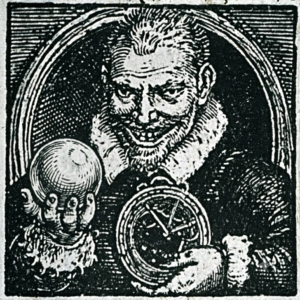
Simon Forman
London, 1552–1611
♣ King of Clubs | Keyword: Ambition
Simon Forman was born in Quidhampton in Wiltshire on the last day of 1552, the son of a farmer. When his father died, his mother pulled him out of school at eleven and put him to work in the fields. He never forgave her for it, and spent the rest of his life educating himself with a ferocity that suggested he was making up for lost time. By the time he died he had produced thousands of pages of guides to astrology, compendia of alchemy, histories of creation, medical records, personal diaries, and notes on the plays of William Shakespeare. He was one of the few people in Elizabethan England to leave a first-hand account of watching Shakespeare perform: his notebooks record attending Macbeth, The Winter’s Tale, and Cymbeline at the Globe, along with a fourth play about Richard II that scholars believe was not Shakespeare’s.
His casebooks survive from 1596 to 1603 and document up to two thousand consultations a year. His clients came with questions about illness, pregnancy, stolen goods, career prospects, unfaithful spouses, and marriage. He recorded all of it in meticulous detail. He also recorded his own dreams, his own ailments, the best time to visit friends, the best time to send letters to patrons, and the whereabouts of his missing socks. He cast horoscopes to find his missing socks. This is not a colourful exaggeration. It is in the Bodleian Library.
The College of Physicians repeatedly fined and arrested him for practising without a licence. He kept practising. He eventually obtained a licence from the University of Cambridge in 1603, by which point he had been doing it for years and had no intention of stopping. He treated the poor and the rich with equal thoroughness. The Countess of Essex consulted him. So did people who could not afford to eat.
He dreamed that he offered to impregnate Queen Elizabeth in order to stop her skirts from dragging in the muddy London streets. He recorded this dream in his notebooks without apparent embarrassment.
Those who have studied him closely have not reached agreement. Barbara Traister found his ambitions unlimited. The Cambridge casebooks project called him pugnacious, ambitious, and controversial. A third scholar concluded he was a humourless, anxious man trying desperately to become something he was not. All three assessments are accurate. None of them is the whole picture.
In September 1611, on a warm Sunday afternoon, he told his wife that he would die the following Thursday night. She argued with him. On Thursday evening he went out onto the Thames in a boat and collapsed. He was dead before they got him to the bank. His casebooks, his manuscripts, and everything else he had ever written passed to his protege Richard Napier, and eventually to the Ashmole Collection at the Bodleian, where they remain. After his death he was implicated in the poisoning of Sir Thomas Overbury through his former client the Countess of Essex, a scandal that kept his reputation buried for centuries.
He was fifty-eight years old. He had written down almost everything that had ever happened to him. The socks were never found.
The image is a whimsical imagining based on the historical record, not an authentic portrait.
Sources:
Sidney Lee, ‘Forman, Simon’, Dictionary of National Biography, vol. 19 (1889). Lauren Kassell et al., The Casebooks of Simon Forman and Richard Napier, 1596–1634, casebooks.lib.cam.ac.uk. William Lilly, History of His Life and Times, from the Year 1602 to 1681 (1715). J. O. Halliwell-Phillipps, ed., The Autobiography and Personal Diary of Dr. Simon Forman (1849). Folger Shakespeare Library, ‘Forman’s account of seeing plays at the Globe: Macbeth, Cymbeline, Winter’s Tale’, Shakespeare Documented (2020), shakespearedocumented.folger.edu. Mathew Lyons, ‘Simon Forman fantasises about Elizabeth I’ (2012), mathewlyons.co.uk. A. L. Rowse, Simon Forman: Sex and Society in Shakespeare’s Age (1974), pp. 210–211. Owen Davies, Popular Magic (2003), p. 95.
Foundational sources are available on The Sources page.