The Cunning Folk
Stories Worth Being Retold
Anne Bodenham
Salisbury, Wiltshire, executed 1653
♣ Queen of Clubs | Keyword: Defiance
Anne Bodenham was eighty years old, and she wore spectacles, and she insisted that everyone call her Mistress. Not Goodwife. Not Widow. Mistress Anne Bodenham, wife of a Wiltshire clothier. She could read. She owned a whole shelf of books, rare enough for a woman of her station to be worth remarking on. She wrote her own letters. She taught the local children their letters too, in a cottage just outside Salisbury, close enough to the gallows that she could see them from her door. That closeness would turn out to matter. She had spent decades building this life, a cunning woman of real standing in her corner of Wiltshire, not a marginal figure scraping by but a respected one. She had earned the distinction.
She said she had learned her craft as a young woman from Dr Lambe, a London astrologer so tangled up in the affairs of the Duke of Buckingham that a mob eventually beat him to death in the street. By the time Anne was standing trial in 1653, he had been dead for around twenty-five years. She knew exactly what she was doing by claiming him: naming the most notorious sorcerer of the previous generation as her own teacher, long after he was safely beyond contradicting her, while she herself was still working, still respected, still Mistress Bodenham. Nobody can prove the story true. It hardly needs to be. It is a magnificent thing to say about yourself, and she said it more than once.
What she actually did, day to day, was practical. People came to her cottage with a specific problem, usually something stolen, and she solved it. Her tool was a green looking glass, held up to the sun, in which she said she could see the thief at their business, wherever they were, like a window opening onto somewhere else. She found a lost gold ring this way. She found a stolen spoon. Once, a visitor arrived and she turned them away flat: the wind was wrong, the sun wasn’t right, Jupiter wasn’t showing its face, so the glass would give her nothing that day. She told them they’d be back before long over something far more serious. She was right.
She wrote small paper charms folded into squares to keep debt collectors from a poor man’s door. She prayed to the planet Jupiter, which she called the luckiest of all the planets. She once boasted to a young clerk that she could pull a live toad out of an empty bag, for the price of a few pints of ale. “I have cured hundreds,” she said of herself, and nothing in the record suggests she was lying about the number.
She also raised spirits, and here the stories get bigger. More than one person who saw her at work described the same ritual: four names spoken aloud, always in the same order, calling on Beelzebub, Tormentor, Lucifer, and Satan. Asked directly what these spirits actually were and what she wanted with them, she gave a plain, matter of fact answer: those who wished to do it need only read the right books, and she had read them. She knew the preparations, the consecrations, what the invocations actually said. And she said there was no harm in the spirits themselves. They did a person nothing but good, watching over them, keeping them from evil, their whole life long. She said this while she herself stood accused of witchcraft, with her life on the line. It’s the one moment in the whole record where we get to hear, in something close to her own words, what she actually believed she was doing. And what she believed was that she was doing good.
The stories other people told about her went further still. One says a boy was carried bodily through the air to a snow-covered field, where a black boar showed him where to dig for magical herbs. Another describes a candlelit gathering where ragged boys danced with a cat and a dog while she sat paring her fingernails, and fresh herbs pushed up through the snow at her word. A cheap printed pamphlet, cashing in on her fame after the trial, claimed she could turn herself into a dog, a lion, a bear, a wolf, a bull, and more. Anne herself, under questioning, made an equally wild claim of her own: that she could travel through the air at forty miles an hour. People said doors opened by themselves when she approached. They said a black dog crossed a particular bridge just ahead of her, every time.
Her downfall came through a servant girl named Anne Styles, who worked for a wealthy family nearby and came to Bodenham for help with a plot to poison her own household. It wasn’t Styles’s first visit. Bodenham wrote her a charm. She also, Styles later said, had her sign her name in blood in a red book kept as a record of everyone who’d bound themselves to the devil. When the poisoning plot was discovered and Styles was arrested, the girl turned on Bodenham at once and blamed her for everything.
Bodenham had already seen this coming. She said plainly, before any of it happened, that Styles had undone her and that she would hang for it. She was right on both counts.
She was tried at Salisbury in 1653, searched for a witch’s mark by four women who swore they’d found it, found guilty on every charge, and sentenced to hang. Through all of it she never once confessed, not to the clergyman who prayed with her in her final days, not to the man pressing her for a confession right up to the foot of the ladder, not with the rope actually around her neck. When the moment came to leave her cell for the last time, she called out to the man come to fetch her: “Be you ready, I am ready,” in what witnesses called a jolly manner, as though she were the one keeping everyone else waiting. Given one last chance to admit her guilt before she died, her final words were fury, not surrender: “Forgive thee? A pox on thee, turn me off.” She tried to jump before the hangman could do it for her.
The strangest ending belongs to someone else. Anne Styles, whose evidence had done more than anything to hang her, broke down afterwards and begged that Bodenham be spared. She said she had felt herself falling toward hell and had been saved, in the end, by nothing more than what she called one little twig, holding her up. It is the most human moment in the whole case, and it very nearly wasn’t written down at all.
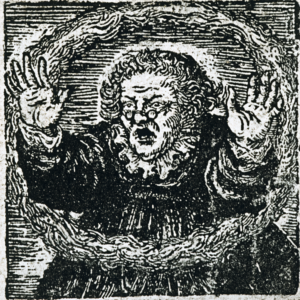
The image is a whimsical imagining based on the historical record, not an authentic portrait.
Sources:
Edmond Bower, Doctor Lamb Revived, or, Witchcraft Condemn’d in Anne Bodenham (1653). Anon. (“James Bower, Cleric”), Doctor Lambs Darling: Or, Strange and Terrible News from Salisbury (1653). Henry More, An Antidote Against Atheism, Book III, ch.7 (2nd edn, 1655), pp.203–204. ‘The Salisbury Assizes, or, the Reward of Witchcraft’ (ballad, 1653), in Hyder E. Rollins, ed., Cavalier and Puritan (1923), pp.329–335. John Aubrey, Remaines of Gentilisme and Judaisme, ed. James Britten (1881), pp.260–261. Owen Davies, Popular Magic: Cunning-folk in English History (2003), pp.63, 145. Malcolm Gaskill, ‘Witchcraft, Politics, and Memory in Seventeenth-Century England’, The Historical Journal, 50:2 (2007), pp.289–308.
Foundational sources are available on The Sources page.